6 min read · with Coach Finn
How Do I Stop Being Scared of Going Downhill on a Bike?
Part of Cycling From Zero, When You Have Not Ridden Since Childhood
Hi, it is Coach Finn. If your stomach drops every time the road tips downward, I want you to hear this first. You are not a wimp, and you are not bad at cycling. Going downhill is the one moment on a bike where you give up a little control to gravity, and your brain notices. That is a healthy, sensible alarm. The good news is that descending is a skill, not a personality trait, and skills can be learned slowly and gently. Let us walk through it together.
Your Fear Is Normal, and It Is Actually Smart
Speed without much protection between you and the ground is exactly the kind of thing a careful brain should respect. So please stop scolding yourself for being nervous. That nervousness is not weakness. It is your body asking for a plan.
Here is the reframe I give every rider I coach. The goal is not to become fearless. Fearless riders crash. The goal is to become calm and capable, so the fear shrinks down to a quiet little hum of focus instead of a scream. We do that by giving your brain something to do with its hands and eyes, which is exactly what the skills below are for.
Before any of that, two non-negotiables. Your helmet goes on every single time, no exceptions. And your bike has to be mechanically sound, which mostly means brakes that actually grab and tires that hold air. If you are not sure your brakes are working well, get them checked at a bike shop before you point yourself down any hill. A confident descent starts with equipment you can trust. If you are coming back to riding after a long break, my guide on getting back on a bike for triathlon is a kind place to begin.
The Body Skills That Do the Heavy Lifting
Most of staying safe downhill is just how you hold yourself. Let us start from the top down.
Relax your grip and your arms. When we get scared, we squeeze the bars in a death grip and lock our elbows straight. That is the opposite of what helps. A stiff, locked rider gets bounced around by every bump and feels every wobble as panic. So unclench. Imagine you are holding two small birds, firm enough that they cannot fly off, gentle enough that you do not hurt them. Bend your elbows a little so your arms can soak up bumps like soft springs. As a bonus, a relaxed grip helps if your hands and feet go numb on the bike, which is often a death-grip problem in disguise.
Look far ahead, where you want to go. This is the big one. Your bike follows your eyes, almost like magic. If you stare at the pothole or the gravel patch you are scared of, you will steer straight into it. So lift your gaze and look down the road to where you want to be in a few seconds. See the line you want, not the hazard you fear, and your hands will quietly follow.
Keep your weight back and low. Slide your hips back just a touch and drop your chest a little toward the bars. This keeps you stable and stops the feeling that you might tip forward over the front wheel. Low and centered is calm. Tall and stiff is wobbly.
Brakes Are Your Friends, So Use Them Gently
Brakes are not the enemy. Bad braking is. Here is how to make them feel safe.
Feather both brakes, early and gentle. Feathering means light, smooth squeezes, like petting that nervous cat, rather than one hard grab. Use both brakes together so the bike slows evenly. The big mistake nervous riders make is waiting until the last second and then clutching the levers hard, which is jerky and scary. Instead, start slowing earlier than you think you need to, with soft pressure, and you will glide down at a speed you choose.
Stay off the front brake hard. Your front brake has most of your stopping power, which is useful, but if you yank it alone, especially on a steep or loose surface, the back of the bike can lift or the front can slide. So lean on your rear brake a bit more for steady control, and add front brake gently and smoothly. Never stab the front lever in a panic. Think pressure, not punch.
Brake before the turn, not in it. This little rule prevents a lot of spills. Do all your slowing on the straight part of the road before a corner arrives. Get down to a comfortable speed, then ease off the brakes and steer smoothly through the bend. Braking hard while you are already leaning into a turn is where tires lose their grip. Slow early, turn relaxed.
Cornering Without the Clenched Jaw
Turns feel scarier than straight descents because there is more going on, so let us make them simple.
As you go through a bend, keep your pedals level, or push your weight down through the outside foot, the one on the far side of the turn. Dropping weight onto that outside pedal presses your tires into the road and makes the bike feel planted and sure. If your inside pedal is down, it can clip the ground when you lean, so level pedals or a weighted outside foot is the safe habit.
Combine it with the eyes skill from earlier. Look through the corner to where the road straightens out, not down at your front wheel. Slow before you enter, look where you want to exit, weight the outside foot, and let the bike carry you around. You do not have to force it. A bike genuinely wants to roll through a smooth turn.
Build It Up Slowly, and Walking Is Always Allowed
Here is the part I care about most. You do not have to be good at this tomorrow. We build confidence in small, boring, successful steps, and boring is exactly what we want.
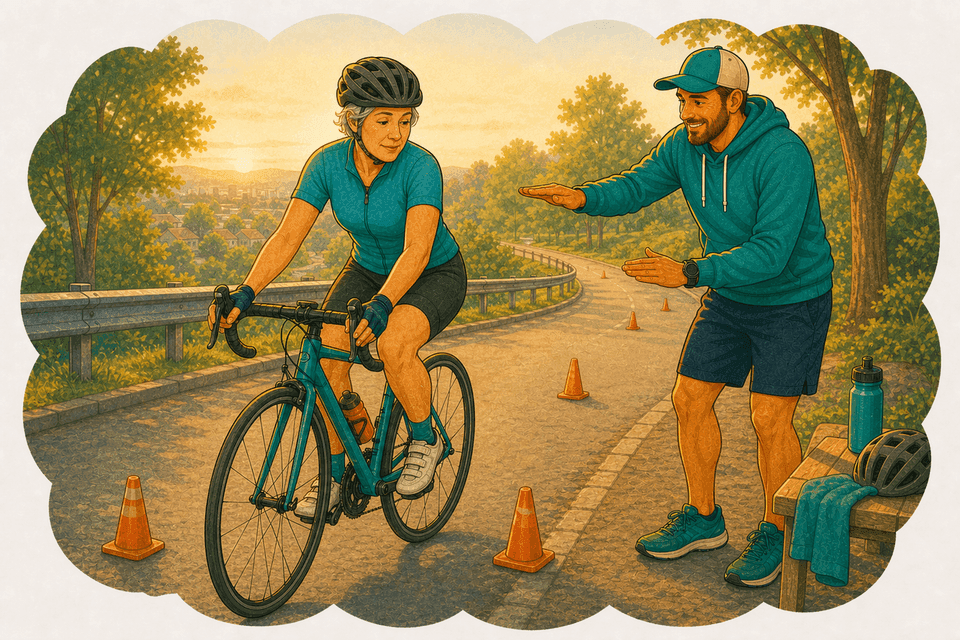
Start on a gentle slope on a quiet, low-traffic road or an empty parking lot with a slight grade. Practice rolling down something so mild it is almost flat. Feather your brakes, relax your arms, look ahead, and just feel what a controlled descent is like when nothing is scary. Do that little hill ten times if you want to. When it feels boring, find one slightly steeper, and repeat. Each gentle success teaches your nervous system that you are safe, and the fear quietly turns down on its own.
And please hear this clearly. If a descent ever looks like too much, you are allowed to slow to a crawl, stop, and get off and walk your bike down. There is no shame in it, none at all. Even seasoned riders walk descents that are wet, steep, or crowded. Walking is not failing. Walking is a smart rider choosing to live to ride another day. The only rule is that you get down safely, however that happens.
Take a breath. You are going to be just fine. Every confident descender you have ever admired started out gripping the bars and holding their breath, exactly like you. They simply practiced, one gentle hill at a time, and so will you. If you are still building your engine from scratch, my cycling from zero guide pairs nicely with this one. Be patient and kind with yourself, keep your hills small to start, and come find more beginner-friendly help anytime at couchtotri.com. You have got this.