18 min read · with Coach Finn
The Swim, and the Fear
There is a thing nobody tells you when you first think about doing a triathlon. The thing that stops most people is not the training, or the time, or the bike you do not own yet. It is one quiet, specific fear, and it lives in the water.
So let me say it out loud before we go one step further, because naming it is how we start to take its power away.
You are scared of the swim. You might not be able to swim freestyle at all. You might not be able to swim a single length of a pool. The idea of putting your face in the water and breathing on purpose might make your chest go tight just reading this sentence.
If that is you, I want you to hear the first true thing in this book: you are not the exception. You are the rule. You are exactly who I wrote this for, and you belong here.
Why does the swim scare me so much?
Here is something that surprised me the first time I really looked at it. The swim is not just one of the reasons people avoid triathlon. It is the number one reason.
Ask around among the coaches who work with beginners and you hear the same thing over and over. Of all the otherwise fit, rational, capable adults who think about doing a triathlon and then quietly decide not to, the thing holding most of them back is the water. Not the distance. Not the bike. Not the run. The swim.
Think about what that means for a second. These are not lazy people or unhealthy people. Many of them run, lift, cycle, chase kids around, hold down hard jobs. They are perfectly able to start training tomorrow. But they look at the swim, feel that drop in the stomach, and quietly decide the whole sport is not for them.
So if you have felt that, you are in enormous company. You are standing in a crowd of millions of capable people who all felt exactly the same way. The fear is not a sign that something is wrong with you. It is the single most normal, most shared, most human reaction to this sport that exists.
And there are good reasons your body reacts the way it does.
Your fear is older than you are
Water is one of the few environments where a human being can be in real danger within seconds. Your brain knows this. It has known it since long before you were born. The part of you that tenses up at the edge of deep water is not weakness or drama. It is an ancient, protective alarm system doing its job.
The problem is that the alarm cannot tell the difference between actual danger and unfamiliarity. To your nervous system, "I do not know how to be in this water yet" and "I am drowning" can feel almost the same. The fix is not to be braver. The fix is to make the water familiar, slowly, until the alarm has nothing left to shout about.
Most of us were never actually taught
Here is the other piece. A huge number of adults who "can't swim" were simply never taught properly. Maybe you had a few chaotic lessons as a kid. Maybe you had a scare once. Maybe you just grew up somewhere without a pool nearby. None of that is a character flaw. It is a gap in your education, and gaps can be filled at any age.
You would not feel ashamed that nobody taught you to fly a plane. Swimming is a learned skill, exactly like that. You were not born knowing it, and almost nobody is. The fact that you do not have the skill yet tells you nothing about whether you can get it. You can.
Do I need to be a strong swimmer to start? No. Here is the truth.
This is the reframe that changes everything, so I want to slow down on it.
You do not need to be a strong swimmer to start your journey to a triathlon. You need to learn to be calm in the water. Those are two completely different things, and almost everyone gets them confused.
When a beginner pictures "learning to swim," they picture power. Churning arms, splashing, going fast, getting fit enough to fight their way across the pool. So they assume the goal is fitness, and that they are too out of shape for it.
But the people who struggle most in the water are almost never the ones who lack fitness. They are the ones who panic. Panic is the real enemy. Not your lungs, not your legs, not your weight, not your age. Panic.
Here is what panic actually does to you in the water. When fear spikes, you tense every muscle. You lift your head to keep your face clear, which pushes your hips and legs down so you sink at the back and feel like you are drowning, which makes you panic more. You hold your breath, so carbon dioxide builds up, and your body screams for air, which feels like suffocating, which makes you panic more. You thrash to stay up, which burns through your energy in seconds, and now you are exhausted and frightened in water that was never going to hurt you.
None of that is a fitness problem. Every bit of it is a calm problem.
And calm is teachable. That is the good news hiding inside all of this. A relaxed beginner who has never trained a day can float, breathe, and glide across a pool more easily than a terrified marathon runner. I have watched it happen many times. Fitness comes later, and it comes quickly once you are calm. Calm comes first.
So when I tell you "you can do this," I am not being a cheerleader. I am telling you the actual mechanism. The skill you are about to learn is not strength. It is the skill of staying relaxed while the water holds you up. You can absolutely learn that, and your fitness, or lack of it, has almost nothing to do with whether you can.
Will I really not be last? (And what if I am?)
Let me answer the question you are too polite to ask out loud. You are afraid of being last. You are afraid of being the slow, scared one while everyone else glides past, and of everyone seeing it.
So here is the honest truth, in two parts.
First, you are almost certainly not going to be last. Beginner triathlons, and especially sprint-distance races, are full of nervous first-timers doing breaststroke, doggy paddle, backstroke, and a lot of standing up to catch their breath. The field is far slower and far more ordinary than the highlight reels make it look. The fast, sleek swimmers you are picturing are a small minority at the front. The vast middle and back of the pack look a lot like you.
Second, and this matters more: someone is always last, and it is almost never the person who is afraid of being last. The people who fear it are the ones who trained, who showed up, who care. They finish in the middle and are stunned they worried so much. And on the rare day that someone genuinely is last, here is what actually happens at a beginner race. People cheer for them. Louder than for anyone else. The last finisher at a triathlon is very often the most celebrated person on the course, because everybody there understands what it took.
I need you to really take in the next sentence, because it is the whole point of the sport.
Finishing is the win. The entire win. There is no asterisk for being slow.
Nobody at the finish line asks your time. They ask if you finished, and when you say yes, you are a triathlete. Full stop. The same as the person who finished an hour ahead of you. You both did the thing that so many capable people are too afraid to even try. Slow and finished beats fast and never-started every single day.
What do I do if I can't swim a single length?
Good. This is the part you actually came for. If you cannot swim one length right now, you are at the perfect starting point, and we are going to build from exactly here.
The method below is the same one good learn-to-swim coaches use, and it is the logic behind approaches like Total Immersion: balance and comfort first, breathing second, and the actual freestyle stroke last. We do not start with the arms. We start with the water holding you up, because everything else is built on top of that.
Read this as a ladder. You do not skip rungs, and you do not move up until the rung you are on feels easy. "Easy" is the only test. If a step still feels scary, you stay there longer. There is no schedule you are behind on. There is only the next small thing that feels safe.
One thing before you get in the water. If you have a heart condition, a breathing condition, or anything that has kept you off exercise, have a quick word with your doctor before you start. It is a five minute conversation, and it means you can relax and put your full attention on the calm work ahead.
Step 1: Get comfortable just being in the water
Before you try to swim anything, your only job is to feel okay standing in the shallow end. That is it. Go to a pool where you can stand with your head well above the water. Walk around. Feel the resistance of the water against your legs and arms. Let your shoulders drop under the surface. Splash your own face on purpose.
This sounds too simple to matter. It is the most important step there is. You are teaching your nervous system that this place is safe, that you are in control, that you can stand up any time you want. Every minute you spend calm in shallow water is a minute the old alarm gets a little quieter.
Spend a whole session here if you need to. Spend three. There is no rush.
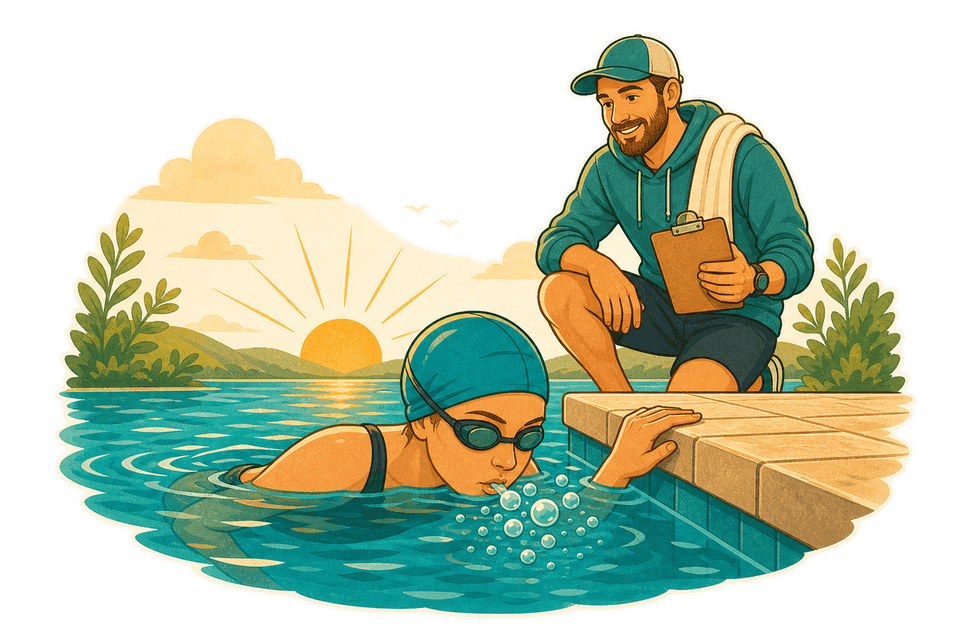
Step 2: Blow bubbles and breathe out underwater
The single skill that prevents the most panic is exhaling underwater. So we learn it early, and we learn it standing up where you are completely safe.
Stand in the shallow end. Take a normal breath, lower your face into the water, and slowly hum or blow the air out through your nose and mouth so you make a steady stream of bubbles. Then lift your face and breathe in. That is one rep. Do it again. Slow and steady, not a panicked gasp.
Here is why this is the secret. Panic in the water is almost always a breathing problem in disguise. Beginners hold their breath, the pressure builds, and the urge to breathe feels like suffocation. When you learn to breathe out slowly and continuously under the surface, that pressure never builds, and the panic has nothing to feed on. Calm breathing is the foundation the whole stroke sits on. Get this comfortable before you do anything else.
Practice until putting your face in and bubbling out feels boring. Boring is the goal. Boring means safe.
Step 3: Float, and let the water hold you
Now the leap of faith, taken in water you can stand up in.
Hold the edge of the pool, take a breath, put your face down, and let your feet lift off the bottom so you are floating face-down, holding the wall. Feel it. The water is holding you. You are not sinking. You do not have to do anything to stay up. When you want air, you simply put your feet down and stand.
Then try it without the wall, in shallow water, for just a second or two. Push gently off the bottom and let yourself float face-down, arms out front, completely relaxed. Stand up whenever you like.
This step is where the deepest fear lives, because it asks you to trust the water instead of fighting it. So here is the physics, because understanding kills fear. Your lungs are full of air. Air floats. With a normal breath in your chest, your body wants to float. The reason beginners sink is not their body. It is that they tense up and lift their head, which drives the hips down. Relax, keep your head down and in line with your spine, and the water does the work. You were built to float. Let it.
Step 4: Balance and body position
Once you can float relaxed, we shape that float into the position you will actually swim in. This is the part casual swimmers skip and good coaches obsess over, because good body position is what makes swimming feel easy instead of exhausting.
Push gently off the wall and glide face-down, arms stretched out in front, body long and level, like you are reaching for the far end. Keep your head down, eyes to the bottom, neck relaxed and in line with your spine. Think long and balanced, not high in the water.
The reason this matters so much: a long, level body slides through water with almost no effort, while a tense, head-up body plows through it and wears you out in seconds. Most of "getting good at swimming" is just learning to hold this calm, balanced line. Practice gliding and standing up, gliding and standing up, until the glide feels smooth and stable.
Step 5: Add the breathing to the movement
Now we put the bubble-breathing from Step 2 together with the glide.
Glide face-down, blowing slow bubbles out the whole time. When you need air, turn your head gently to one side, keeping one cheek in the water, and let your mouth clear the surface just enough to sip a breath, then turn your face back down and keep exhaling. You are not lifting your head up and forward. You are rolling it to the side, low, where there is a little pocket of air right next to your face.
This feels awkward at first for everyone. That is normal and it passes. The key is that you never hold your breath: bubbles out under the water, sip in to the side, bubbles out again. Smooth and continuous. When the breathing flows, the panic has nowhere to live.
Step 6: Build the freestyle stroke piece by piece
Only now do we add the arms, and we add them one piece at a time, never all at once.
Start with a gentle kick from the hips, legs long and loose, while you hold your glide. Small and relaxed, not a frantic splash. Then add one arm reaching forward and pulling back, then the other, slow and unhurried, while you keep that long balanced body and that steady breathing. Reach, pull, breathe, repeat.
Do not chase speed. Speed is a trap this early. Chase smooth. A slow, relaxed, ugly freestyle that you can keep doing is worth ten times more than a fast one that leaves you gasping at the wall. We are assembling a stroke you can repeat, not winning a race. Let it be slow. Let it be imperfect. Keep it calm.
Step 7: From 25 meters to continuous
Your first real milestone is one length of the pool without stopping. Usually that is 25 meters. When you first reach the far wall without putting your feet down, I promise you will feel something light up in your chest. Remember that feeling, because that is the feeling of a fear losing its grip on you.
From there, we stretch it gently. Rest at the wall as long as you need, then go again. Then link two lengths with a short rest. Then three. Then we shorten the rests. Bit by bit, 25 becomes 50, becomes 100, becomes "I lost count," and one day, swimming continuously stops feeling like a wall you are pushing against and starts feeling like something you simply do.
That is the whole ladder. Comfort, bubbles, float, balance, breathing, stroke, distance. Every triathlete who once could not swim climbed these same rungs. So can you.
What should I actually do this week?
Let me make this real, because a plan you do not start is worth nothing.
This week, your entire job is Step 1 and Step 2. Nothing more. Go to a pool one or two times. Stand in the shallow end where you can easily touch the bottom. Walk around, get your shoulders wet, splash your face. Then practice blowing slow bubbles with your face in the water, lifting up to breathe, and doing it again. That is the whole assignment.
You are not allowed to try to swim a length this week. I mean that kindly. Trying to swim before you are calm is exactly how the panic spiral starts, and we are not doing that. This week is about making the water boring and safe. If by the end of the week putting your face in and bubbling out feels easy, you have had a hugely successful week, and you are genuinely on your way. Next week we float.
Small, calm, repeatable. That is how this whole thing gets done.
What about open water? Isn't a lake totally different?
Yes. I am going to be honest with you, because you deserve honesty, not a comfortable lie.
Open water, a lake or the sea, is a different thing from the pool. There is no line on the bottom to follow, no wall to grab, no clear view of your own hands. The water is cooler, sometimes choppy, sometimes dark. The first time most people put their face in open water, the old alarm goes off all over again, even if they are perfectly comfortable in a pool. That is normal too. It catches almost everyone.
So here is the plan, and the plan is the same as everything else in this chapter: we do not throw you in. We desensitize to open water gradually and safely, exactly the way we made the pool boring. You start by standing in calm, shallow open water and just getting used to how it feels. You get the cool water on your hands, your face, the back of your neck before you ever put your head down, so the cold shock has no power over you. You float near the shore. You swim short stretches parallel to the bank, where you could stand up any time. Only much later, only when calm water near shore feels easy, do you go a little further.
And one rule that has no exceptions, ever: you never swim open water alone. Not once, not "just this once." Always with a buddy, a coach, a lifeguard, or a supervised group. This is not about fear. It is what every experienced open-water swimmer on earth does, including the elites. Open water earns respect, and respecting it is part of being good at it.
But all of that comes later. It is a chapter further down the road, and we will walk it together when you get there. For right now, today, this week, your water has a wall, a shallow end, and a line on the bottom. That is all you need to begin.
How CouchToTri coaches this, so you never face it alone
I will keep this part short, because you do not need a sales pitch. You need to know you have a guide.
Everything in this chapter, the exact ladder from "scared to put my face in" all the way to "swimming continuously," is how I coach the swim inside CouchToTri. We start you from wherever you genuinely are, including zero, including "I have never swum freestyle in my life," and we walk you up one rung at a time. We never skip ahead of your calm. The app meets you where you are and adjusts, so the next step is always small enough to feel safe and big enough to be progress.
We coach the run the same gentle way. You do not start by running. You start with the run-walk method, the same proven logic behind couch-to-5k: short bouts of easy running with walking in between, building up bit by bit as your body adapts, so you never get hurt and never get discouraged. Run a little, walk a little, repeat, and over the weeks the running grows and the walking shrinks until one day you are simply a runner. Same philosophy as the swim. Start tiny, stay calm, build slowly, finish proud.
That is the whole method, for all of it. Meet you where you are. Explain the why. Take the fear seriously instead of pretending it away. Then climb, one safe step at a time, until the thing that felt impossible becomes the thing you do.
The swim is first because it is the scariest, and we are starting here on purpose. If you can make peace with the water, and you can, the rest of this journey opens up in front of you.
So take a breath. Bubbles out, slow and steady. We start this week.