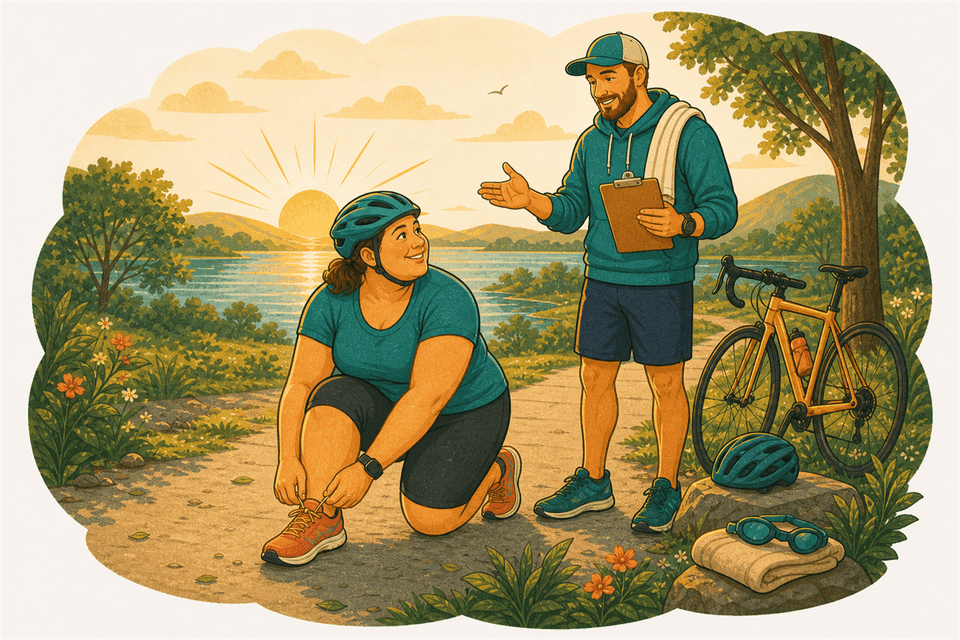
5 min read · with Coach Finn
Can I Do a Triathlon If I Am Overweight?
Part of How Long Does It Really Take to Go From the Couch to a Full Ironman?
The short answer
Yes, you can do a triathlon if you are overweight.
Not because weight does not matter at all. It can change how running feels, how gear fits, how heat affects you, and how quickly your joints tolerate impact. We do not pretend those things away.
But weight is not a door that locks you out of the sport.
The better question is not, "Am I light enough to start?" The better question is, "What is the safest first step for the body I have today?"
That is a much kinder question, and it is also a much more useful one.
You do not need to lose weight before you begin
This is where many people get stuck. They decide they will train after they lose weight, after they feel less self-conscious, after they can jog without stopping, after they look more like the athletes in the photos.
That delay can last years.
Training is not a reward for already being fit. Training is the path that helps your body become more capable. You are allowed to begin now, gently, without earning the right to move first.
The goal of the first month is not a number on a scale. The goal is a body that trusts you because you did not throw it into too much too soon.
Why triathlon can be friendlier than running alone
If you are carrying more weight, running is usually the part we treat with the most patience. That is not judgment. That is physics. Each step asks your feet, ankles, knees, hips, and tendons to absorb impact.
Triathlon gives us two gifts:
- The bike lets you build endurance with less impact. You can work your heart and lungs while your body weight is supported by the saddle.
- The pool supports you. Water takes load off your joints and lets you practice breathing, movement, and confidence without pounding.
That means your early plan can lean on walking, biking, and pool work while running grows slowly through run-walk intervals. You are still training for a triathlon. You are just choosing the smartest route in.
What should your first week look like?
Start with boringly repeatable work.
- Two easy walks, 15 to 30 minutes.
- One easy bike ride or stationary-bike spin, 15 to 25 minutes.
- One pool visit, not for laps yet, just water comfort and breathing practice.
- One rest day after any session that leaves your joints sore.
If that sounds too easy, good. Easy is how you build the habit without scaring your body. We can add later. We cannot build consistency on top of dread.
A joint-kind run-walk start
Do this only if walking 20 to 30 minutes already feels manageable and you have no pain that changes your gait.
Warm up with 5 minutes of easy walking.
Then repeat this 6 times:
- Walk 90 seconds.
- Jog 20 seconds, softer and slower than you think.
- Walk until your breathing feels normal again.
Cool down with 5 more minutes of walking.
That is a run session. Not a failed run. Not "barely anything." A real first run session.
If your knees, shins, feet, hips, or back feel sharp pain, stop. Muscle fatigue is normal. Joint pain that changes how you move is information. Respect it.
What about embarrassment?
Let us say the quiet part.
You may be afraid people will look at you and think you do not belong.
At a beginner triathlon, you will see more body types than the internet shows you. You will see first-timers, older athletes, bigger athletes, nervous athletes, people on hybrid bikes, people doing breaststroke, people walking the whole run. The front of the race is only one small slice. The rest of the field looks much more human.
And the people who volunteer at these races are not there to judge you. They are there to help you finish.
Your body does not need to look like a triathlete's body before you start. A triathlete's body is a body that trains for triathlon. That can be yours now.
Gear fit matters more than fancy gear
For a heavier beginner, comfort is not vanity. It is adherence.
Get shoes that feel stable and comfortable. If you can, go to a running shop and be fitted. Use clothes that do not rub. If a bike saddle hurts after every ride, change the saddle or adjust the fit. If goggles leak, replace them. None of this has to be expensive, and there is more in what gear you actually need for your first triathlon. It just has to remove friction. The best gear is the gear that lets you come back tomorrow.
When to check with a clinician first
Please get medical clearance before starting a training plan if you have chest pain, fainting, unusual shortness of breath, dizziness, a heart or lung condition, uncontrolled blood pressure, diabetes concerns, joint pain that limits walking, or any symptom that worries you.
That is not me saying no. It is me saying we want the green light before we load the engine.
FAQ
Should weight loss be the main goal?
For your first triathlon, no. The main goal is consistent training, safe progression, and a finish line you feel proud of. Body composition may change as a side effect. It should not be the permission slip.
Should I start with a sprint triathlon?
Yes. A sprint is the right first mountain for most beginners. It is still a real triathlon, but it is sized for learning.
Can I walk the run?
Yes. You can walk parts of it, or all of it, as long as you stay within the race rules and cutoffs. As covered in can you walk the run in a triathlon, run-walk is smart beginner training, not a compromise.
The bottom line
You are not too heavy to start. You are too important to start recklessly.
So we begin gently. We let the bike and pool carry more of the early load. We walk before we run. We pick a beginner-friendly sprint. We measure progress by consistency, not by shame.
One safe step today. Another one this week. That is how a finish line gets built.
Coach Finn builds your plan around your real body and your real joints, leaning on the gentle disciplines first. Get medical clearance before starting a new exercise program if you have any condition or symptom that concerns you.