4 min read · with Coach Finn
Do You Need Strength Training for Triathlon?
Part of Strength, Durability, and Staying Off the Sidelines
The honest answer
You do not need a gym, a barbell, or a complicated lifting program to finish your first triathlon. Plenty of people complete their first sprint with zero formal strength training.
But here is the more useful answer: a small amount of simple strength work is the single best insurance against the injuries that derail beginners, especially as your running builds. So while it is not required to finish, it is one of the highest-value things you can add. Think of it less as bodybuilding and more as durability training, the stuff that keeps you healthy enough to keep showing up.
Why it matters for a beginner
When you go from the couch to training three sports, the limiter for most people is not their heart or lungs. It is their tissues, the muscles, tendons, ligaments, and joints, struggling to keep up with the new load. Running is the main culprit, because it is high impact and the body needs time to toughen up.
A little strength work helps in three ways:
- It builds the supporting muscles around your hips, knees, and ankles, which take a beating when you run.
- It improves your balance and control, so your form holds together when you get tired.
- It makes you more durable, so you can absorb the gradual increase in training without breaking down.
The goal is not to get strong for its own sake. It is to stay healthy enough to finish your training.
What to actually do (it is simpler than you think)
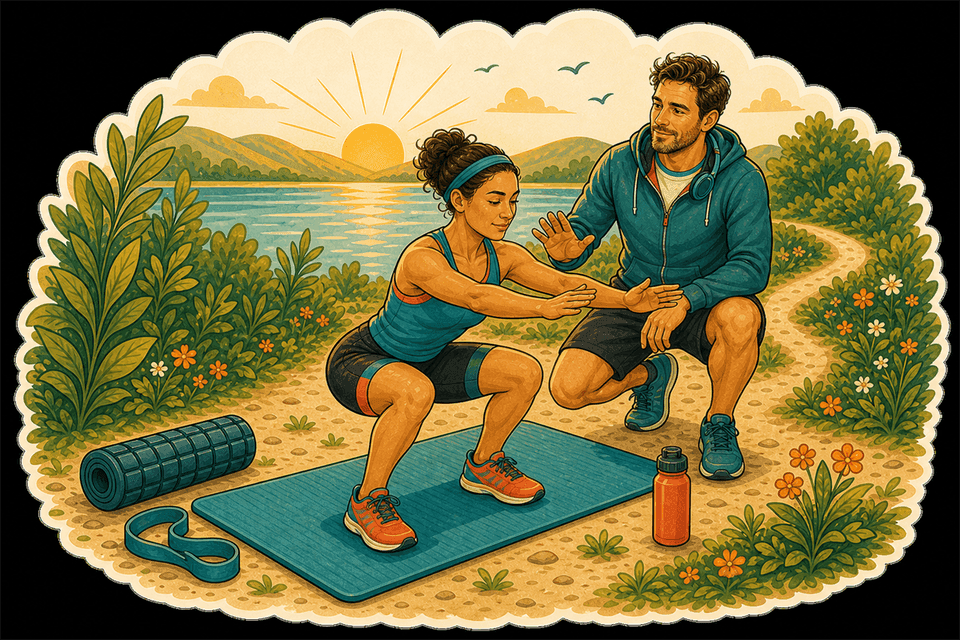
You do not need equipment. A short, twice-a-week routine of basic bodyweight movements covers most of what a beginner needs. Focus on the legs, hips, and core, the areas that protect your running.
A simple starter set:
- Squats or sit-to-stands from a chair, for your legs and hips.
- Lunges or step-ups, which also train balance and single-leg strength.
- Glute bridges, for the hip muscles that protect your knees and back.
- A plank or other core hold, for the trunk stability that keeps your form together.
- Single-leg balance, simply standing on one foot, which quietly builds the ankle and hip control that prevents a lot of running niggles.
Two short sessions a week, fifteen to twenty minutes each, is plenty to start. You do not need to be sore or exhausted. Consistency beats intensity here.
Form first, always
If you take one principle from this, take this: good form matters far more than how much you lift or how many you do. A clean, controlled squat with no weight is worth more than a sloppy, heavy one.
- Move slowly and with control.
- Keep the range of motion comfortable and pain-free.
- Stop a set when your form starts to fall apart, not when you cannot do another rep.
- If something hurts in a sharp or joint way, stop and reassess. Muscle effort is fine; joint pain is a signal.
If you have a history of injury, joint problems, or any medical condition, talk to a qualified professional, like a physical therapist, before starting a strength routine. A few sessions of personalized guidance is a great investment.
When to add it, and when to back off
Strength work can start early and run alongside your swim, bike, and run training. A few practical notes:
- Keep it on easier training days, not right before your hardest sessions, so it does not leave your legs trashed for a key run.
- As your race approaches and your training tapers, the strength work eases off too.
- If you are very sore or run-down, skip a session. Strength work supports your training; it should never wreck it.
FAQ
Will skipping strength training stop me from finishing?
No. Many people finish a first sprint without it. But adding a little reduces your injury risk, which is the most common reason beginners do not make it to the start line. It is insurance, not a requirement.
Do I need a gym or equipment?
No. Bodyweight movements at home, done twice a week, cover the basics. You can add light weights or resistance bands later if you enjoy it, but they are not necessary to start.
How much should I do?
Two short sessions a week, around fifteen to twenty minutes, focused on legs, hips, and core, with good form. You should not be wrecked afterward. Little and often is the model.
What if I have an old injury?
Get personalized guidance before starting, ideally from a physical therapist or qualified professional. They can tailor the movements to protect your specific issue, which is far safer than guessing.
The bottom line
You do not need strength training to finish, but a simple, twice-a-week bodyweight routine focused on legs, hips, and core is the best injury insurance a beginner can buy, and it costs nothing but a little time. Form first, keep it light, and let it protect the training that gets you to the finish line.
Coach Finn weaves a little durability work into your plan so the building blocks of your running stay healthy. This is general education, not individual medical advice. If you have an injury or condition, consult a qualified professional before starting.