21 min read · with Coach Finn
Strength, Durability, and Staying Off the Sidelines
Let me start by saying the thing you are most afraid of, out loud, so we can deal with it together.
You are worried that this whole adventure is going to hurt you. That your knees, your back, your shoulders, the parts of you that have been quiet on the couch for years, are going to start complaining the moment you ask them to do real work. You have maybe felt a twinge already, just walking around, and a little voice said, see, your body is not built for this.
I want you to hear me clearly. That fear is reasonable, and it is also beatable. Getting hurt is not some random curse that strikes the unlucky. Most beginner injuries come from a few specific, predictable mistakes, and every one of them can be avoided. This chapter is the whole toolkit for staying healthy, and the biggest tool in it is one almost no nervous beginner expects.
It is strength training. Lifting. Yes, you, the person who has never touched a barbell and feels a bit silly even reading the word. By the end of this chapter you will understand why a little strength work is the single highest-leverage thing you can do to protect your body, you will know a simple beginner approach, and you will be able to recognize the common triathlon niggles early enough to nip them in the bud.
One note before we go further. If you have an existing injury, a joint problem, or any condition that affects how you move, have a quick chat with your doctor or a physio before you start loading it. That is one short conversation that buys you a lot of peace of mind.
Do I really need to lift weights for triathlon?
Short answer: not heavy, not a lot, but yes, and it might be the best decision you make all year.
Here is the mental hurdle most beginners trip over. They picture strength training and they see bodybuilders, huge mirrors, grunting, weights that look terrifying. They think, that is not me, I just want to finish a triathlon. So they skip it entirely and pour all their time into swimming, biking, and running.
That is a mistake, and it is a mistake about what strength training is actually for. For an endurance athlete, lifting is not about getting big. It is about getting durable. Those are completely different goals, and yours is durability.
Think about what a triathlon actually does to you. It is hours of the same motion, over and over, the same pedal stroke, the same footstrike, the same arm pull, thousands of times. That repetition is where endurance injuries come from. They are rarely one dramatic moment. They are a slow accumulation of stress on tissues that were not ready for it, and a little strength work is how you get those tissues ready.
Let me give you the four real reasons, plainly.
It builds the resilience of your tendons, ligaments, and bones. When you lift, you are not just training muscle. You are sending a signal to the connective tissue and the skeleton to get tougher. Tendons become stiffer and stronger, bones get denser, and the whole structure becomes better at absorbing the repetitive pounding of swim, bike, and run. This is the deep scaffolding that keeps you in one piece, and strength work is how you build it.
It improves your economy. Economy is just a fancy word for how much energy it costs you to move at a given pace. The research here is genuinely strong: heavy or explosive strength training reliably improves running economy, meaning you use less energy to run the same speed. A stronger body is a more efficient body. You get a little free fitness that does not cost you any extra lung-burning effort.
It keeps your form intact when you are tired. This one matters enormously and beginners never think about it. Near the end of a long effort, when you are exhausted, your form falls apart. Your hips sag, your knees cave in, your shoulders slump. And bad form under fatigue is exactly when injuries happen. Strength training gives you a reserve of stability so that when the tiredness comes, you hold your shape instead of collapsing into the positions that hurt you.
It is the highest-leverage prevention tool you have. When supervised programs are studied, the people who strength train tend to get hurt less and stick with their training more. It is not a magic shield, and the science is still arguing about the edges. But of all the things you can do to stay healthy, a small, consistent strength habit gives you the most protection per minute invested.
So no, you do not need to become a powerlifter. You need a modest amount of the right movements, done consistently. Let me show you exactly what that looks like.
What does a simple strength routine for a beginner look like?
Here is the good news that will lower your blood pressure: this is far simpler than the internet makes it look.
You do not need a complicated program with dozens of exercises. You need a handful of basic human movements done with good form, a couple of times a week. That is it. We are going for movement quality, not heroic weights.
The whole approach rests on one principle I want you to tattoo on your brain: form over load, always. A clean movement with no weight beats a sloppy movement with a heavy weight, every single time, especially when you are starting out. For your first several weeks, your only job is to learn the movements well. The weight can come later, slowly, once your body knows the patterns. Rushing is exactly how people get hurt doing the thing that was supposed to keep them healthy.
The five movement patterns that cover almost everything
You can build a complete beginner routine from five basic patterns. Learn these, and you have hit nearly every muscle that matters for triathlon.
A squat. Bending at the knees and hips to lower down and stand back up, like sitting into a chair and rising again. This builds your legs and teaches your knees to track properly. You can literally start with a box or a real chair behind you, sitting down and standing up, and that counts.
A hinge. Bending forward from the hips with a flat back to load your backside and hamstrings, then standing tall. This is the king of the posterior chain, the muscles along the back of your body that power your run and protect your lower back. Start with no weight, just the movement, hands sliding down your thighs.
A press. Pushing weight away from you, either overhead or away from your chest. A simple push-up, even done against a wall or on your knees, is a perfect press for a beginner. This keeps your shoulders, the most injury-prone joint in swimming, strong and stable.
Core work. Not crunches. Think planks and anti-movement exercises, where your job is to hold steady and resist your body twisting or sagging. A simple plank held with good form is worth more than a hundred sit-ups for an endurance athlete.
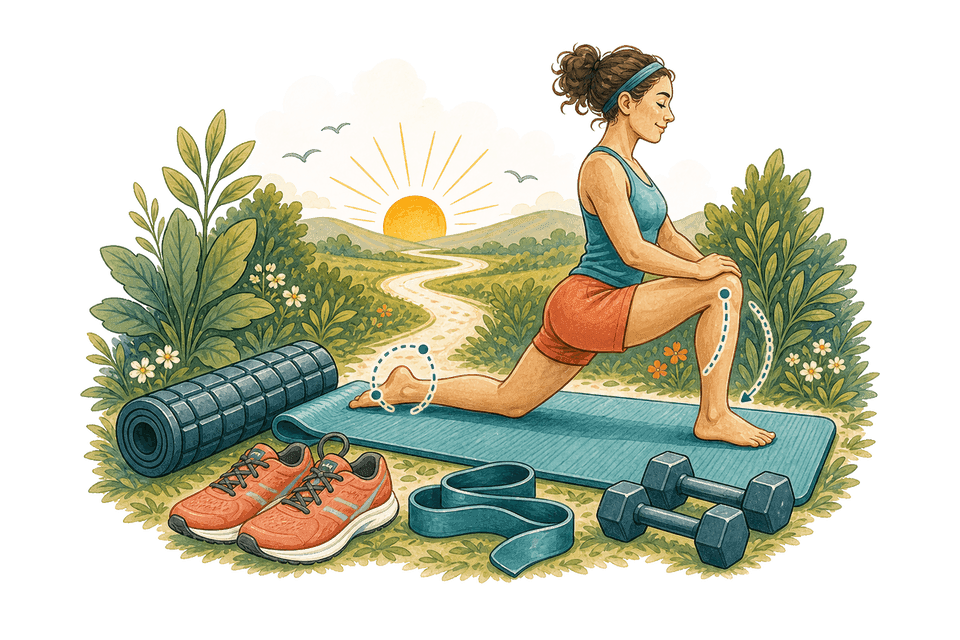
Single-leg work. Anything done on one leg at a time, like a step-up onto a low box, a slow single-leg balance, or a gentle split squat. This is the unsexy work that quietly saves your knees, and it gets its own section below because it matters that much.
That is the whole menu. Squat, hinge, press, core, single leg. Pick one of each, do a couple of easy sets, and you have a complete session in twenty to thirty minutes.
How often should I do it?
Here is the simple rhythm.
In your off-season, when your swim, bike, and run volume is lower, aim for two to three short strength sessions a week. This is when you have the most spare energy, so it is the time to build your foundation.
As you get into your race season and your endurance training ramps up, dial the strength work down to about once a week. At that point you are not building new strength, you are just maintaining what you already built, and one weekly session does that nicely while leaving your legs fresh for the important swim, bike, and run sessions.
And if you are brand new to all of this, spend your first three to six weeks doing nothing but learning the movements with light or no load. Build the patterns first. Earn the weight later. Your tissues will thank you.
Why is the boring single-leg and core work so important?
I know. Squats and presses at least feel like real exercise. Standing on one leg wobbling around feels faintly ridiculous, and planking face-down on the floor is nobody's idea of glory. This is the unsexy work. It is also, for an endurance athlete, some of the most protective work you will ever do, so stay with me.
Here is the thing about running. It is not really a two-legged activity. It is a series of single-leg landings. Every stride, your entire body weight comes down on one foot, and one leg has to absorb that force and stabilize you before it happens again on the other side. If that single leg is not strong and stable, the force does not just disappear. It leaks out into your joints in ways they were not designed to handle.
This is where your hips come in, and specifically the muscles on the side of your hip, the glutes. When those muscles are weak, your knee tends to cave inward every time you land. The research connects that inward collapse, what physios call knee valgus, directly to a long list of knee injuries. Weak hips up top, painful knee in the middle. The knee often gets the blame for a crime the hip committed.
So the unglamorous single-leg and hip work, the step-ups, the balance drills, the side-lying leg raises, is really knee insurance. It teaches your hip to hold your knee in a safe line under load. You will never see it on a highlight reel. It is one of the highest-value things in this entire book.
Core work plays the same quiet protective role. Your core is the link between your upper and lower body, and a stable core keeps your pelvis level and your spine supported through thousands of repetitions. When your core fatigues and your midsection starts to sag and sway, the stress travels straight into your lower back and hips. A simple, strong plank habit keeps that chain solid.
None of this is flashy. All of it keeps you healthy. Do the boring work. It is the work that lets you keep doing the fun work.
What about stretching and mobility?
Let me clear up a common confusion first, because the words get muddled. Mobility is your ability to move a joint through its full, useful range with control. It is not the same as being able to fold yourself into a pretzel. You do not need to be a gymnast. You need joints that move freely enough to let you swim, bike, and run without forcing your body into awkward compensations.
And here is why it matters for staying healthy: when one joint is restricted, the stress does not vanish. It moves somewhere else, usually somewhere that is not built to take it.
The clearest example is your ankle. If your ankle is stiff and cannot flex properly, that restriction travels right up the chain. The research is quite direct about this: limited ankle motion changes how your knee and hip behave when you land, nudging your knee into those risky inward positions and feeding into problems like Achilles trouble and knee pain. A stiff ankle can become a sore knee. That is the whole story of mobility in one sentence: restriction in one place becomes injury in another.
The same goes for tight hips. Triathletes spend a lot of time hunched in a folded position on the bike, and that can leave the hips and the front of the body tight and restricted, which then changes how you run. Free, mobile hips let you run and pedal in a natural, powerful position instead of fighting your own body.
You do not need a long, complicated stretching routine. A few minutes of gentle mobility work for your ankles, hips, and shoulders, especially the joints that feel stiff to you, goes a long way. Move them through their range, keep them supple, and you remove a whole category of injuries before they ever start. Think of it as oiling the hinges so nothing has to grind.
Why do I have to build up so slowly?
Now we arrive at the single most important idea in this entire chapter, the one principle that, if you truly absorb it, will protect you more than anything else. I am going to say it plainly and then explain it, because it is that important.
Your engine gets fit faster than your frame gets tough.
Here is what that means. When you start training, different parts of your body adapt at very different speeds. Your heart and lungs, your aerobic engine, respond quickly. Within a couple of weeks of training, you genuinely feel fitter. Your breathing gets easier, you can go longer, and a wonderful, dangerous thing happens: you feel ready to do more.
But your tendons, your ligaments, and your bones do not work on that timeline. Connective tissue and bone adapt much, much more slowly than your cardiovascular system. We are talking weeks and months, not days. Studies on tendons show it can take two months or more before they meaningfully strengthen and remodel. Bone takes its own slow path too.
Do you see the trap now? Your engine tells you that you are ready for more, long before your frame actually is. You feel great, so you add miles, push the pace, train harder. Your heart and lungs can handle it. But your tendons and bones are still back at the starting line, quietly getting overloaded with every session. And one day they say enough, and that is your injury.
This is the real reason behind every too-much-too-soon injury a beginner ever gets. It is not weakness. It is a timing mismatch between a fast engine and a slow frame.
So the answer is simple, even if it asks for patience: you build gradually, on purpose, to give the slow tissues time to catch up to the fast engine. This is why coaches preach increasing your training by only small amounts at a time, and why we build in easier weeks where your tendons and bones quietly remodel. Those holdbacks are not your fitness being wasted. They are your frame catching up to your engine. The patience is the point.
When you feel impatient, when your lungs are screaming to do more and you feel held back, I want you to remember this: the feeling of being ready is your engine talking, not your tendons. Build at the pace of your slowest-adapting tissue, and you will outlast every beginner who listened only to their lungs.
What are the most common beginner triathlon injuries?
Let me walk you through the usual suspects, the niggles that catch beginners most often. The goal here is not to scare you. It is the opposite. When you know what these feel like in their early, whisper stage, you can act early and keep them small. The injuries that end people's seasons are almost always the ones they ignored when they were still just a whisper.
Through every one of these runs a single rule, and I am going to repeat it until you are sick of it because it is the rule that matters most: never train through sharp pain or joint pain. Muscle soreness and general tiredness are fine. Sharp, specific, or joint pain is a stop sign. We will come back to this.
What are shin splints and how do I fix them?
Shin splints are that aching, tender soreness along the inside edge of your shin bone, usually showing up during or after running. It is one of the most common beginner complaints, and it is almost always a pure overload injury: your shins getting more pounding than they have adapted to handle yet.
Catch it early when it is just a mild ache that warms up and fades. The fixes are the things this whole chapter is built on. Back off your running volume, give it more rest, run on softer surfaces like grass or trails when you can, take quicker and lighter steps instead of heavy pounding ones, and build up your calf and lower-leg strength gradually. If you respect it early, shin splints settle down. If you keep grinding through them, they can progress toward a bone stress injury, which is a far longer and more serious problem. So do not be stubborn here.
What is runner's knee?
Runner's knee is a dull ache around or behind your kneecap. It often shows up going down stairs, after sitting with bent knees for a while, or as your runs get longer. The root cause is usually a mix of too much load too soon and weak hips letting the knee track poorly, which loops right back to that single-leg and glute work we talked about.
Early on it is just a niggle. The medicine is to reduce your running load for a bit, rest, and add that hip and glute strengthening that keeps the knee tracking in a safe line. Strengthen the hip, settle the knee.
What is swimmer's shoulder?
Swimmer's shoulder is the catch-all name for shoulder pain from the repetitive overhead motion of freestyle. It can feel like an ache or a pinch at the front or top of the shoulder, often worsening as your swim sessions get longer. The shoulder is the body's most mobile and least stable joint, which makes it vulnerable to overuse.
Early signs are a mild ache during or after swimming. Address it by easing off swim volume, paying attention to your stroke technique so you are not forcing the joint into bad positions, and keeping the muscles around the shoulder blade strong and stable, which is exactly what your press and pulling strength work does. A stable shoulder is a happy shoulder.
What about Achilles and plantar problems?
Two foot-and-ankle issues round out the list.
Achilles tendinopathy is pain and stiffness in the cord at the back of your heel, the Achilles tendon. It is classically worst when you first get going, like the first steps out of bed in the morning, and it often eases as you warm up, which is exactly why it is so easy to dismiss. It comes from overloading the tendon faster than it can adapt, which by now you know is the recurring theme of every endurance injury.
Plantar fasciitis is a sharp or deep ache underneath your foot, from the heel toward the arch. Its signature is that it hurts most with your very first steps in the morning or after sitting for a while, then settles a bit as you move. Both of these respond well to early attention: reduce your load, build up your calf and foot strength gradually, and progress your running with patience rather than leaps.
When should I stop and rest, and when should I see a professional?
This might be the most practical skill in the whole book, because it is the one that decides whether a small problem stays small or becomes the thing that ends your season. So learn the difference between two things that feel similar but are completely different.
Discomfort is normal. Pain is information.
Discomfort is the general stuff: tired legs, muscle soreness for a day or two after a hard session, breathing hard, that pleasant ache of having worked. That is your body adapting, and you can keep training around it. It is fine. It is even good.
Pain is different. Pain is sharp. Pain is specific, located in one precise spot you could point to. Pain lives in a joint. Pain gets worse the longer you go, or it changes the way you move so you start limping or favoring a side. That kind of pain is not something to push through. It is information, and the information is: stop.
So here is the rule, one more time, because it is the heartbeat of this whole chapter: never train through sharp pain or joint pain. Not once. Not to finish the session. Not to keep your streak alive. The macho instinct to push through is exactly how a two-day niggle becomes a two-month injury. Backing off early is not weakness. It is the smartest, most advanced thing an athlete can do, and it is what keeps you training year after year while others sit on the sidelines.
When you feel that kind of pain, stop the session. Rest the area for a few days. Most early niggles, caught at the whisper stage, calm right down with a little rest and a sensible easing of load. That is the magic of acting early.
And here is when to stop self-managing and see a professional, a doctor or a physiotherapist. Go and get it looked at if:
- The pain is sharp, severe, or came on suddenly.
- It does not improve after a week or so of rest and easing off.
- It keeps coming back every time you return to training.
- It changes how you walk or move, or it hurts during normal daily life, not just during exercise.
- Anything about it worries you. Trust that instinct.
Seeing a physio is not an admission of failure or a sign you are not cut out for this. It is exactly what smart, experienced athletes do. A good physio will often find the simple cause, usually a weakness or a restriction somewhere, give you a few targeted exercises, and have you back training quickly. Catching something early and getting the right guidance almost always means a short detour instead of a long, miserable one. There is no medal for guessing in the dark while a fixable problem gets worse.
To be clear, nothing in this chapter is a diagnosis or a treatment plan for your specific body. It is the general map. For real, persistent, or worrying pain, a professional who can actually look at you is always the right call.
A gentle word to close
Let me bring this all back to where we started, with that fear of getting hurt.
Here is what I hope you can see now. Injury is not some random misfortune waiting to strike you. It is mostly the predictable result of a few avoidable mistakes, and you now know every one of them. You build a little strength so your tissues are tough and your form holds when you are tired. You do the unsexy single-leg and core work that protects your knees. You keep your joints mobile so stress does not leak into the wrong places. And above all, you build gradually, at the pace of your slowest-adapting tissue, because your engine is always ready before your frame is.
And you never, ever train through sharp or joint pain. You treat early niggles as the small, fixable whispers they are, and you get real help when something needs it.
This is exactly how CouchToTri is built. Every plan we give you ramps up slowly and deliberately, with rest and easier weeks baked right in, precisely because we know your tendons and bones need time to catch up to your heart and lungs. We respect your recovery as much as your training, because the recovery is where the strength is actually built. We are not trying to make you fit as fast as possible. We are trying to get you to the start line, and then the finish line, healthy and whole and still enjoying it.
You are not fragile. You are just untrained, and untrained is the most fixable thing in the world. Build the quiet strength, respect the slow tissues, learn the difference between discomfort and pain, and your body will carry you a great deal further than you currently believe.
You can do this, and you can do it without breaking. Let me show you how, one careful step at a time.
That is the whole idea behind your plan at couchtotri.com. Start one for free and I will ramp you at the pace your tendons and bones can actually follow, with the easy weeks built in for you, so you spend your time training instead of mending.