17 min read · with Coach Finn
The Fear of Finishing Last
Let me start with the thing you have been carrying quietly, maybe for months, maybe for years.
You want to do a triathlon. Some part of you really wants it. And another part of you is sure you do not belong anywhere near one. You picture the start line and you do not see yourself finishing. You see yourself last. Slow. Red-faced. Heavier than everyone else. Watched. Judged. The one person who clearly wandered into the wrong sport and embarrassed themselves trying.
So before we go a single sentence further, I want to say the quiet part out loud, because naming a fear is how we start to take its power away.
You are afraid of being last. You are afraid of being slow while everyone watches. And underneath both of those, you are afraid you are not a "real" triathlete and never will be, that you are a fraud for even thinking about it.
If that is you, here is the first true thing in this chapter: you are not the exception. You are the rule. Nearly everyone who has ever stood on a start line felt some version of this, and a huge number of them felt it exactly as sharply as you do right now. You are not broken. You are not weak. You are normal, and you belong here. Stay with me, because I am going to show you why.
Why am I so afraid of being last?
Let me tell you why this fear has such a grip on you, because it is not silliness and it is not vanity. It is human, and it is old.
Being last in front of a group is one of the oldest social fears we have. For most of human history, being the slowest, weakest, most visible member of the group was genuinely dangerous. Your brain still runs that ancient program. When you imagine being last and seen, the same alarm fires that fired for your ancestors. It feels like a threat to your safety, even though the only thing actually at risk is your pride.
So the dread you feel is not drama. It is an alarm system doing its job. The problem is that the alarm cannot tell the difference between real danger and "I might look slow at a sporting event I signed up for voluntarily." To your nervous system, those can feel almost the same.
Here is what helps. The alarm gets quieter when the unknown becomes known. Most of this fear lives in your imagination, in a vivid little horror movie you have been screening for yourself. Through this chapter, we are going to replace that movie with the truth about what actually happens at a beginner triathlon. And the truth, I promise you, is far kinder than the film in your head.
What if I finish last?
Let me answer the question you are too polite to ask out loud, in two honest parts.
First, the boring statistical truth: you are almost certainly not going to be last. I know that does not feel true right now. But think about who fears being last. It is the person who trained, who showed up, who cares enough to worry. People who do not care never enter. The very fact that you are reading a chapter like this one tells me you are the type who prepares, and prepared people overwhelmingly finish somewhere in the great wide middle, then stand there afterward stunned that they spent so long afraid.
A beginner sprint triathlon is not the highlight reel you are picturing. The front of the race, the sleek fast people in aero helmets, that is a tiny minority. The vast middle and back of the pack is full of ordinary humans doing breaststroke, doing run-walk, stopping to catch their breath, riding hybrid bikes with the seat a little too low. The field is far slower, far heavier, far more nervous, and far more like you than any photo ever shows. You will look around at the start and feel a wave of relief, because you will see your own people everywhere.
Now the second part, the part that matters more. Suppose the unlikely thing happens. Suppose, on some particular day, you genuinely are the last person to cross the line.
Here is what actually happens when you are last at a triathlon, and I need you to really take this in, because it is the opposite of your horror movie.
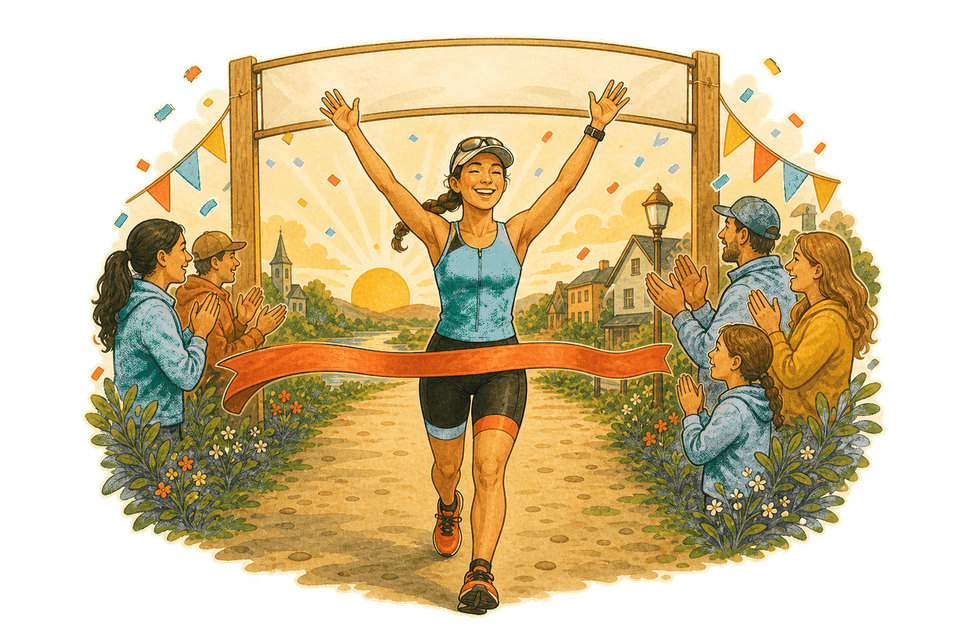
People cheer for you. Louder than for almost anyone. At the back of the pack, volunteers stay late on purpose. Spectators line up. At big races there are people called tailwalkers whose entire job is to walk the course with the last athletes so nobody finishes alone, a moving cheer squad just for you. There are documented races where the final finisher is met by a crowd, by camera flashes, sometimes by a professional athlete who walked back out onto the course to hand them their medal in person.
The last finisher at a triathlon is very often the most celebrated person on the course. Not the most pitied. The most celebrated. Because every single person standing there understands exactly what it took to be out there the longest, to keep moving when it would have been so much easier to stop, to refuse to quit. The back of the pack is not where shame lives. It is where the loudest love on the whole course lives.
So let me say the thing this whole chapter is built around.
Finishing is the win. The entire win. There is no asterisk for being slow, and there is no asterisk for being last.
Nobody at the finish line asks your time. They ask if you finished. And when you say yes, you are a triathlete, exactly as much as the person who finished an hour ahead of you. You both did the thing that most people are too afraid to even attempt. Slow and finished beats fast and never-started every single day of the week.
Am I too out of shape to do a triathlon?
This is the fear wearing different clothes, so let me speak to it directly.
You are looking at your body right now and deciding it disqualifies you. Too heavy. Too unfit. Too far gone. You have built a quiet rule in your head that says you have to fix the body first, get in shape first, earn the right, and then maybe, someday, you would be allowed to begin.
I want to gently take that rule apart, because it has it exactly backward.
You do not get in shape and then start triathlon. Triathlon, done kindly and slowly, is how you get in shape. Fitness is not the entry fee. It is the prize you collect along the way. Every single fit triathlete you are intimidated by started as someone less fit than they are now. There is no other route. Nobody was issued their fitness at birth. They walked up the same slope you are looking at, and they started from wherever they were, which for many of them was a couch.
The beginner end of triathlon is full of bodies of every shape and size. Heavier athletes, older athletes, post-surgery athletes, post-pregnancy athletes, people who could not climb a flight of stairs without stopping six months earlier. They are not rare. They are the soul of the back and middle of the pack, and they are some of the most respected people in the entire sport precisely because everyone can see how far they have come.
Your body is not a thing to be ashamed of and hidden until it is "acceptable." It is the thing that is going to carry you across that line. It is already, right now, exactly enough to begin. Not in some future improved version. Today's body, today.
I feel like a fraud calling myself a triathlete
Now we get to the deep one. The one that whispers even after you have trained, even after you have done the work. Imposter syndrome.
Imposter syndrome is the feeling that you do not truly belong, that you are faking it, that any second now someone is going to look at you and realize you are not a real athlete and never were. It tells you that everyone else got a membership card you never received. It is incredibly common, and it is a liar.
Here is something that should set you free a little. The pros feel this too. This is not me being nice to you. It is documented, over and over, by elite triathletes who win the actual races. Olympic medalists have admitted they did not feel worthy to stand on the start line, even with the medals already around their necks. Professional athletes write openly about feeling like out of their depth, like they had not done enough, like the title did not really belong to them. If a person who literally wins world-class triathlons can feel like a fraud, then the feeling is clearly not evidence about your ability. It is just a feeling that human achievers get, especially the ones who care. It tags along with effort. It is almost a sign you are taking something seriously.
So please stop treating that feeling as a verdict. It is weather, not a fact.
And now the line I want you to underline, memorize, write on your mirror if you need to.
If you train, you are a triathlete. Full stop.
Not when you finish your first race. Not when you hit some weight. Not when you can swim a mile or own a fancy bike or look the part. The moment you start training toward a swim, a bike, and a run, you are a triathlete. The same way a person who runs around the block is a runner, and a person who sits down and writes is a writer. It is in the doing, not in the proving. You do not have to earn the noun. The training is the noun.
You are not preparing to maybe one day possibly become a triathlete if you are good enough. You are a triathlete who is in training, exactly like every other triathlete on earth, all of whom are also still in training, because that is just what the word means. Welcome. You are already one of us. You have been since you started.
Will people judge me for being slow?
Let me answer this one plainly, because the answer surprises almost everyone.
The people you are most afraid of, the fit, fast, experienced triathletes, are overwhelmingly the kindest people on the course toward beginners. I know that sounds too good to be true. But triathlon culture, especially at the local and beginner level, has a strong and genuine ethic of welcoming newcomers. Experienced athletes remember being terrified beginners themselves, often quite recently. They are not standing in judgment of your pace. Many of them will cheer for you, give you room, tell you "great job" as they pass, and mean it.
The fast people are also, frankly, not watching you. They are deep inside their own race, their own pain, their own pacing, their own nerves. The harsh, sneering crowd you are imagining does not exist at a triathlon. It is a ghost your fear built. Real start lines are full of nervous, friendly, supportive ordinary people who are far too busy being scared themselves to spare a single thought judging you.
And the volunteers? The volunteers love the slow finishers most of all. Ask anyone who has handed out water at the back of a race. The people coming through slow and late and refusing to quit are the ones who make the volunteers cry the good kind of tears. You will not be tolerated back there. You will be adored.
How do I stop tying my worth to my pace?
Here is a trap I want to pull you out of before it ever closes on you, because it can quietly poison the whole journey if you let it.
It is the habit of measuring your worth as a person by your time, your pace, your placing. Sport psychologists who work with athletes at every level warn about this constantly, because tying your self-worth to your performance is a setup for a fall. If your value depends on being fast, then every slow day, every bad workout, every person who passes you becomes evidence that you are not enough. That is a brutal, unwinnable game, and it is also just not true.
The athletes who stay happy and stay in the sport for the long haul, the experts find, are the ones who anchor their worth to things they actually control. Effort. Showing up. Consistency. Progress against their own past, not against a stranger's pace.
So let me draw a hard line for you, and I want you to keep it forever.
Your pace is information. It is not a measure of your value as a human being.
A slow swim split tells you about your swim, on that day, in those conditions. It tells you absolutely nothing about whether you are smart, kind, brave, worthy, or loved. Those are not on the clock. They never were. You can be the slowest finisher on the entire course and be one of the most courageous people there, and both of those things are simply, plainly true at the same time.
When you separate your pace from your worth, something wonderful happens. The fear of being slow loses most of its teeth. Because being slow stops feeling like a confession of failure and starts being what it actually is: a completely neutral fact about how fast you happened to move on a given day. And neutral facts cannot shame you.
Practical tools to quiet the fear
Naming the fear is the first move, and we have done that. Now let me hand you the actual tools, the things you can use this week, so this does not stay as nice feelings on a page.
Talk to yourself like a coach, not a critic
Listen to the voice in your head for a day. For a lot of nervous beginners, that voice is a vicious little critic. "You are too slow. You look ridiculous. Everyone can tell you do not belong."
We are going to retrain that voice, and the science here is simple and real. The goal is not fake, syrupy positivity. The goal is to reframe a self-defeating thought into one that points you forward. The classic example from sport psychology is perfect: do not let it sit at "I am so slow." Reframe it to "I want to get faster, and I am working on it." Same honesty, completely different direction. One pins you in place. The other gives you somewhere to go.
A good rule: speak to yourself the way you would speak to a frightened friend you loved. You would never tell that friend they were pathetic and did not belong. You would tell them they were brave for showing up. Give yourself the same voice. That voice, the kind one, is the voice I want you to think of as me, Finn, in your corner. Borrow it until it becomes your own.
Choose a first race that is built for nerves
You get to stack the deck in your favor, and you absolutely should. Not every race is the same, and your first one should be chosen to be gentle on a nervous beginner.
Pick a sprint. The sprint distance is the shortest standard triathlon, and it is the right place for almost everyone to start. It is long enough to be the real, full experience and short enough that you can train for it without your life falling apart.
Look for a pool-based swim if open water scares you. Many beginner sprints have you swim in a pool, with a wall always within reach and a line on the bottom, which removes one of the biggest sources of dread in one stroke.
Choose a smaller, local, beginner-friendly race over a giant production. Smaller races feel relaxed and welcoming. Some clubs even run beginner-only mini-triathlons with walk-throughs and debriefs, designed from the ground up for people who have never done this and are openly nervous. Those exist specifically for you.
A race chosen this way is not cheating. It is wisdom. You are setting up your first experience to be one you can win, and winning means finishing and feeling good, nothing more.
Find your people
Almost nothing dissolves the fear of not belonging faster than discovering a room full of people exactly like you. So go find them.
Local triathlon clubs are full of friendly people who were beginners once and love nothing more than helping a new one. Many run beginner clinics, group swims, Q and A nights, and practice events. Walking into one can feel scary for a day. After that, it is often the thing that makes the whole journey feel possible, because suddenly you are not a lone weirdo attempting something absurd. You are a normal member of a warm, slightly obsessed, deeply welcoming little tribe.
You do not have to join anything to belong, but if the loneliness or the doubt is heavy, community is the medicine. Being surrounded by other beginners, and by kind veterans, is often the moment the imposter feeling finally goes quiet.
Decide carefully who you tell
Here is a smaller tool that matters more than people expect: you get to choose who knows.
Telling people can be powerful. The right people will cheer you on, hold you accountable, and show up at the finish line with a homemade sign and tears in their eyes. That can carry you through hard days.
But you are allowed to keep it private too. If telling certain people would only invite eye-rolls, doubt, or that special draining flavor of "you, a triathlon, really?", you have my full permission to tell them nothing at all. This can be a quiet thing you do just for yourself, revealed only when and if you choose, maybe with a finish-line photo and no warning whatsoever. Protect your fragile new dream from anyone who would step on it. There is no rule that says your brave thing has to be a public thing.
You decide. That is the point. The journey is yours.
You belong here, and we built this for you
I will keep this last part honest and short, because you do not need a sales pitch. You need to know you have a guide who actually gets it.
Everything in this chapter is the spirit of how CouchToTri and I coach you, on purpose, by design. We did not build this for the fast people who already feel like they belong. We built it for the nervous beginner. For the person who is scared of being slow, scared of being last, scared they are a fraud. For you.
So the whole thing is built around milestones and encouragement instead of metrics and shame. We celebrate the first time you put your face in the water, the first 25 meters, the first time you run and walk a whole loop, the first time you string the swim and the bike and the run together. We meet you exactly where you are, including zero, including scared, and we walk you up one small, safe step at a time. We never hold up your pace against a stranger's and ask you to feel bad. That is not coaching. That is just shame with a stopwatch, and we do not do it here.
When you train with us, you will not be measured against the front of the pack. You will be measured against yesterday's you, and you are going to beat that person again and again, which is the only race that has ever actually mattered.
So let me leave you with the truth this whole chapter has been carrying toward you.
You belong here. You belonged the moment you let yourself want this. You are not too slow, not too out of shape, not too late, not a fraud, and not, in any way that counts, alone. You are a triathlete in training, which is simply what a triathlete is.
And on the day you cross that first finish line, fast or slow, middle or dead last, with a crowd cheering or with just me in your corner where I have been the whole time, you will know something you cannot un-know. You will know you were never the person who could not. You were always the person who had not yet.
Now let us begin.