18 min read · with Coach Finn
The Gear You Actually Need (and All the Stuff You Can Ignore)
Let me say the thing that is going to take a weight off your chest before we go any further.
You do not need a 10,000 dollar bike. You do not need a carbon wonder-frame, a wind-tunnel helmet, race wheels, a power meter, or a closet full of branded kit. You do not need any of the gleaming, expensive things you have seen in photos of triathletes who look like they were carved out of a marketing brochure.
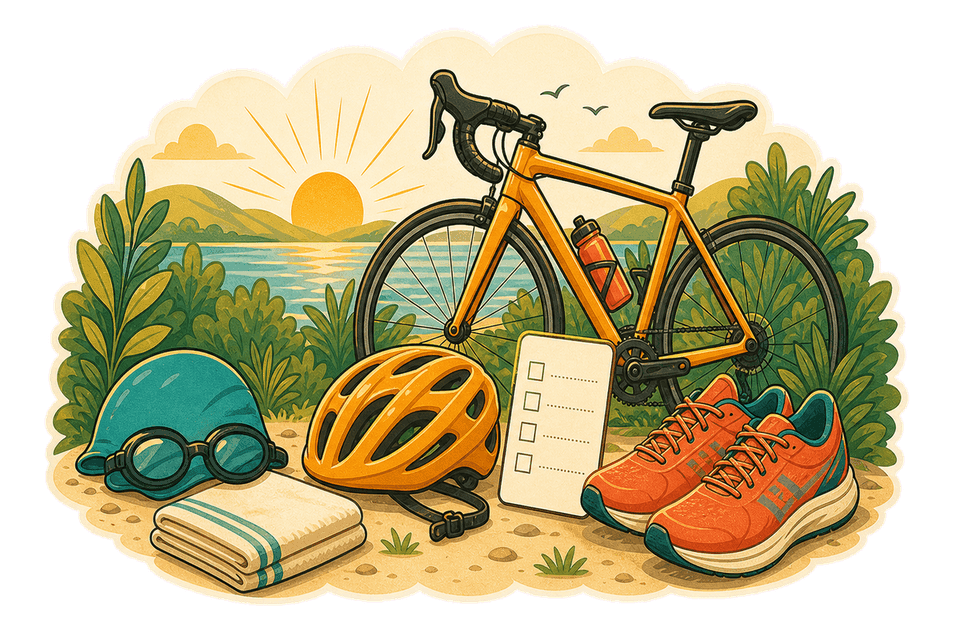
To start triathlon, you need a swimsuit, a pair of goggles, a bike that works, a helmet that fits, shoes that fit your feet, and something comfortable to wear. That is genuinely close to the whole list, and most beginners can get to their first sprint race for a few hundred dollars, much of it the race entry itself.
So if the thing keeping you on the couch is a quiet fear that this sport is only for people with money, let me pull that fear into the daylight. It is not true, and the people selling you gear have a reason to want you to believe it is.
Why does triathlon feel so expensive?
Triathlon has a marketing machine, and that machine is very good at its job: making you feel the gap between you and the finish line is one you can close with a credit card. Faster bike, lighter wheels, slicker suit, smarter watch. Every product is sold with a promise of speed, and every promise is designed to make the thing you already own feel like the reason you are slow.
It is not the reason you are slow. You are slow because you are a beginner, and beginners are slow, and that is completely fine and completely temporary. No purchase changes that. Only time and consistency do.
So read the rest of this as permission: to spend almost nothing, to borrow and buy used, to ignore the hype, and to start as you are.
What gear do I actually need for my first triathlon?
Let me give you the real list. Not the aspirational one, not the one that sells you add-ons. The short, honest list of what you truly need to train and finish your first sprint triathlon.
For the swim: A swimsuit you can move in, and goggles that fit your face. If your race is in cold open water, you may also need a wetsuit, but we will talk about renting or borrowing that.
For the bike: A bike. Almost any working bike: road, hybrid, mountain, borrowed. It needs working brakes, inflated tires, and a chain that turns. Plus a helmet that fits, the one bike item you must have and must not skimp on.
For the run: Running shoes that actually fit your feet. Not fashionable, not expensive, just properly fitted.
For race day comfort: Something you can swim, bike, and run in without changing. A tri suit is the neat solution, but snug shorts and a top you can get wet in will get you to the line.
That is the whole list of true essentials. Everything else in this chapter is a small extra, a comfort item, or a thing you can ignore until you have a few races behind you. Keep this list in your head, and let it quiet the noise every time a brochure insists you are missing something.
How much does it cost to start triathlon?
Let me put real numbers on it, because vague reassurance is cheap and you deserve specifics. Think of it as three tiers, and pick the one that fits your life.
Tier 1: The bare minimum
The "I want to find out if I even like this without spending real money" tier, and a completely legitimate way to start.
- Goggles: a cheap, comfortable pair. Around 15 to 25 dollars.
- Bike: the one in your garage, or a borrowed one. Zero dollars.
- Helmet: borrowed, or bought basic and safety-certified. Zero to 50 dollars.
- Running shoes: the ones you own, if they fit and are not falling apart. Zero dollars.
- Race clothing: snug shorts and a top you already have. Zero dollars.
With a usable bike and decent shoes, you can be ready to train for almost nothing and ready to race for the cost of goggles plus the entry fee. That is the truth the industry would rather you not hear.
Tier 2: The sensible setup
Where most beginners land once they decide they are doing this. You are not chasing speed, you are buying comfort and reliability so training is pleasant instead of a chore.
- Well-fitting goggles, plus a spare. 30 to 50 dollars.
- A tri suit, so you do not change in transition. 60 to 120 dollars.
- A used road bike or hybrid in good condition. Often 300 to 800 dollars.
- A new, properly fitted, safety-certified helmet. 50 to 100 dollars.
- Running shoes fitted at a store. 100 to 150 dollars.
- A basic repair kit: spare tube, tire levers, a mini pump or CO2 cartridges. 30 to 50 dollars.
- A water bottle and a cheap cage for the bike. 15 to 25 dollars.
A sane, durable kit that carries you through your first season and beyond, spending where it makes life easier rather than where it buys status.
Tier 3: Nice to have
Things you buy later, if and when you want them, once you have a few races behind you and know what you actually care about: a GPS watch, clipless pedals and bike shoes, your own wetsuit rather than a rental, a second pair of running shoes to rotate, a heart-rate strap.
Notice what is on none of these lists: the carbon tri bike, the aero wheels, the power meter, the race-day helmet shaped like a teardrop. Those are not beginner purchases, or even early-intermediate ones. They are for a version of you that may or may not exist someday, and that future you can decide for themselves. Today you is off the hook.
What can I buy used?
This is where you save the most money, because two specific items are practically begging to be bought secondhand.
A bike. The used bike market is a gift to beginners. A road bike that cost someone 1,500 dollars new can often be found for a few hundred a few years later, and it will be a far better bike than anything new at that price. People buy bikes, ride them twice, and sell them barely used when life gets busy. Their loss is your gain. Look at local listings, bike shop trade-ins, and tri club noticeboards. A good used bike is one of the best deals in the sport.
A wetsuit. Wetsuits are expensive new and very findable used, because plenty of people buy one, do one race, and move on. You can often find a perfectly good used one for a fraction of the price. Even better for your first race: many races and tri shops rent them, so you pay a small fee, use it once, and decide later. Renting first is the smart, cheap move.
You can also happily buy used: a bike pump, an indoor trainer, bottles and cages, a transition bag, even a tri suit if you find one that fits and is clean. None of these care about being secondhand.
What should I never cheap out on?
There is a short list where saving money is a false economy, and in two cases a safety risk. Spend properly here.
Your helmet, and buy it new. This is the one piece of safety equipment you own, and it has one job: to protect your skull. It does not need to be expensive or aerodynamic. A 50 dollar helmet that meets the safety standard (look for a certification like CPSC) protects your head just as well in a crash as a 300 dollar one. So buy cheap here, but buy new. A used helmet can carry invisible damage from a previous impact that quietly ruins its ability to protect you: it might look perfect and be useless. Cheap is fine. Used is not.
A bike that fits you. You do not need an expensive bike, but you do need one that fits your body and is set up properly. The wrong size, or a bad setup, will make you sore, slow, and miserable, and can cause real injury over the miles. The good news: a basic bike fit is cheap and one of the best dollars you will ever spend in this sport, and many shops do one for a modest fee or include it when you buy. A cheap bike that fits you well beats an expensive bike that does not, every single time. The frame is not what matters most. The fit is.
Shoes that fit your feet. More on this below, but running shoes are not where you save money by guessing. The brand barely matters. The fit matters enormously.
So here is the rule, simple enough to remember at the checkout: cheap out on almost everything, but never on your helmet (and buy it new), never on a proper bike fit, and never on shoe fit.
A plain-language tour of the gear, category by category
Here is each piece, jargon removed: what it does, whether you need it, and where you can ignore the upsell.
Swim gear: goggles and the wetsuit question
Goggles are the only swim purchase you truly cannot skip, and they are cheap. The whole game is fit, not price. A pair that seals against your face without crushing it, and does not leak, is the right pair, whether it costs 15 dollars or 50. Try a few on if you can: press them gently to your eyes without the strap, and if they suction and hold for a second, the shape fits your face. Anti-fog and a bit of tint for sunny open water are nice, and that is about all you need.
A swim cap is often handed out at races, and you will want one for training too. A few dollars. Done.
The wetsuit is the swim item people stress about, so let me make it simple. It does two wonderful things for a nervous beginner: it keeps you warm in cold water, and it makes you float. That extra buoyancy is a genuine confidence gift, holding you up while you are still learning to be calm. Most races allow a wetsuit when the water is at or below about 78 degrees Fahrenheit, and a lot of beginner races sit in that range, so a wetsuit is usually an option you will be glad to have. In colder water a wetsuit can move from allowed to required, and in very warm water it can be banned, so always check your race rules.
But you do not need to own one to start, and may not need one at all if your first race is a warm-water or pool-based sprint. So: rent or borrow it for your first race, buy it used if you fall in love with open water, and only consider an expensive new one much later, if ever. Do not let the wetsuit question become a reason to delay. It is a rental away from solved.
Bike gear: do I need a tri bike or can I use a road bike?
Let me answer the big one, because it stops so many beginners cold.
You do not need a tri bike. A road bike is the better choice for a beginner, and any working bike will get you through your first race.
Here is the difference in plain terms. A tri bike is built for one thing: going fast in a straight line while you lie low over the handlebars in an aggressive aero position. It is twitchy, uncomfortable for a beginner, harder to handle, and a lot more expensive. A road bike is more comfortable, easier to control, easier to learn on, and more useful for the rest of your riding life. For a back-of-the-pack beginner, the speed difference between the two over a sprint is tiny, and dwarfed by your own fitness, which is the thing you are actually here to build.
So the order of preference is simple. Best beginner buy: a comfortable used road bike that fits you. Totally fine: a hybrid. Completely acceptable to start: the mountain bike or cruiser already in your garage, maybe with the knobby tires swapped for smoother ones. At your first sprint, the parking lot is full of every kind of bike imaginable, and nobody is judging yours. The tri bike question can wait years, or forever.
Pedals and bike shoes are optional and a Tier 3 item. You can ride your whole first season in regular running shoes on flat pedals, and many beginners do. Clipless pedals (a confusing name, since they actually clip your shoe to the pedal) let you push and pull through the stroke a little more efficiently, but they take practice, and yes, everyone tips over at a stop sign at least once while learning. No rush. Flat pedals and running shoes are a fine place to begin.
Bottles and a cage are cheap and worth it. Staying hydrated on the bike matters, especially as rides get longer, and the two together cost a few dollars. Easy yes.
A basic repair kit is small, cheap, and saves your day: a spare inner tube, two tire levers, and a way to put air in (a mini pump or CO2 cartridges). Learning to fix a flat is a genuinely useful skill, and it turns a puncture into a ten-minute pause instead of a long walk home.
Lights matter if you ride on roads in low light. A front white light and rear red light make you visible to drivers and are non-negotiable if you train near traffic or in early morning dark. Cheap. Get them.
Run gear: shoes, and almost nothing else
The run is the simplest leg to equip, a nice gift after all that bike talk.
You need running shoes that fit your feet. That is the whole list. Not the most cushioned, not the most expensive, not the pair the magazine ranked first. The pair that fits and feels good when you run.
The single best thing you can do is go to a proper running shop and have them watch you walk or jog, then fit you to a shoe that suits your foot and stride. It costs no more than buying blind online, and it can be the difference between running happily and nursing a sore knee. The brand on the side does not matter. The fit does.
One more rule that matters: do not wear brand-new shoes on race day. Run in them for a few weeks first. "Nothing new on race day" is a phrase you will hear a lot, and it starts with your shoes.
Race-day extras: the small stuff that makes a day smooth
A few little items make race day easier, and none are expensive.
A tri suit is the one piece of triathlon-specific clothing actually worth considering as a beginner. It is a single garment you swim, bike, and run in without ever changing. It dries fast, it has a thin bike pad that is not so bulky it ruins the run, and it saves you fumbling with wet clothes in transition. You do not strictly need one (snug shorts and a top will do), but it smooths the day, and affordable ones exist. This is the rare bit of branded kit I will actively nudge you toward.
A race belt is a cheap elastic strap that holds your race number so you do not have to pin it to your clothes. It clips on in seconds and lets you spin the number from your back (bike) to your front (run). A few dollars, real convenience.
Body Glide or any anti-chafe balm prevents the rubbing wet skin, seams, and a wetsuit collar can cause. Apply it before you start, to the spots that rub. Cheap insurance against a miserable, raw finish.
Nutrition carriers are just the little ways you carry your fuel and drink. For a sprint, that might be nothing more than a bottle on the bike and a gel tucked in your suit. Longer races later mean storage boxes and bottle setups, but for your first race, keep it simple: one bottle, maybe one gel, and you are set.
Do I need a watch, a power meter, or a heart-rate strap?
Short answer: no, not to start. These are useful tools, not requirements.
A GPS watch is genuinely handy. It tracks your time, distance, and pace, and makes following a training plan easier. But it is a convenience, not a necessity. A basic watch and a free phone app will track your runs and rides perfectly well at first, so you can begin today with the phone in your pocket and no watch at all. When you want one, a simple entry-level GPS watch does everything a beginner needs. You do not need the top model with maps and metrics you will never read.
A heart-rate strap can help you learn to train at the right easy effort, a real skill. But you can learn it for free, using how you feel and whether you can hold a conversation. A nice-to-have for later, not a day-one purchase.
A power meter measures your effort on the bike in watts. It is genuinely useful for structured training, and also a purchase a beginner does not need yet. You do not need precision to ride easy and build fitness. You need consistency, and consistency is free.
Here is the principle under all of it: tech can describe your training, but it cannot do your training. A free app and a willingness to show up will take you to your first finish line just as surely as a wrist full of sensors. Buy the gadgets later, for fun, and do not let not owning them become one more reason to wait.
Where does money actually buy speed, and where does it buy nothing?
Let me be completely honest, because you deserve the truth and not a sales pitch.
For an elite racing for a podium, money does buy speed. Aero wheels, a slippery frame, a race helmet, a power meter and the coaching to use it: at the pointy end, these shave real seconds off a finish decided by seconds. I will not pretend otherwise.
But here is the part the brochures bury. For a beginner, for a back-of-the-pack finisher, for the person reading this and wondering if they belong: that expensive gear buys you almost nothing. The seconds it saves are invisible next to the minutes (sometimes the tens of minutes) that your developing fitness, your pacing, and your nerves will account for. You cannot buy your way past being new.
What actually makes you faster as a beginner is not in any shop. It is consistent training, learning to swim calmly, riding more, running more, getting fitter week by week, and showing up on race day rested and ready. Every one of those is free or close to it. So spend where it buys comfort, safety, and a smooth day, and skip everything sold as "free speed," because for where you are right now, it is neither free nor speed. It is just expensive.
Start with what you have
Here is where I want to leave you, because it is the whole point of this chapter.
Go look at what you already own. A bike in the garage, even a dusty one. Shoes you can run a little in. An old swimsuit. That, plus a cheap pair of goggles, is very likely enough to begin training this week. Not someday, once you have saved up. This week, with the wrong things, which turn out to be exactly the right things, because they get you moving.
You do not have to look like a triathlete to become one, and you do not have to spend like one either. The expensive version of this sport is real, but it is optional, it is for later, and it answers a different question than the one you are asking right now. Your question is simply: can I start? Gear-wise, the answer is yes, almost certainly today, with what is already in your home.
That is exactly how CouchToTri is built to meet you. We start you from where you genuinely are, with what you genuinely have, and the plan adjusts to your bike, your body, your budget, and your week. We will never tell you to buy something before you are allowed to begin, because you do not need to, and because the buying was never the hard part. Showing up is the hard part, and that is the part we help you do.
So go find your stuff. Pump up the tires. Dig out the goggles. We have everything we need, and we always did.