5 min read · with Coach Finn
Sighting Drills You Can Practice in a Pool
Part of Open Water and the Swim Panic Nobody Warned You About
Picture this: you are out in a lake, swimming hard, feeling pretty good about yourself. You stop to check your progress and realize you have drifted way off to the side. You added a hundred extra meters without meaning to. This happens to almost every new triathlete, and the fix has a name. It is called sighting, and the wonderful news is that you can start practicing it today in your regular pool.
What Sighting Is and Why It Matters
Sighting is simply lifting your eyes to look forward and check your direction while you swim. In a pool, you never have to think about this. There is a big black line painted on the bottom of the lane, and it guides you straight from one wall to the other. Open water has no black line. There are no lane ropes, no walls, and often no clear way to tell where you are going once your face is in the water.
Without sighting, you tend to swim in a gentle curve, usually toward your stronger arm. Curving means swimming farther than you need to, which means more time and more energy spent for the same race. Sighting keeps you pointed at your target so you swim the shortest, straightest path you can. It is one of the most valuable open-water skills you can build, and it costs you almost nothing to learn.
The Good News: You Can Practice This in a Pool
You do not need open water to get good at sighting. You do not even need to leave your lane. Every part of the technique, the eye lift, the timing, the smooth return to your stroke, can be rehearsed in the same pool you already swim in. By the time you get to your first lake or bay, sighting will already feel familiar instead of brand new. That is a huge head start, and it takes a lot of the nerves out of the experience. When you pair this with your first open-water swim checklist, you will show up feeling ready instead of rattled.
The Technique: Crocodile Eyes
Here is the move you are practicing. Just before you would normally turn your head to breathe, you lift your eyes forward out of the water. Think low. You want only your eyes, or your eyes and the top of your goggles, to break the surface. Picture a crocodile gliding along with just its eyes showing above the waterline. That is the look you are going for.
The sequence goes like this: eyes forward first, look at your target, then roll your head to the side to take your breath as your eyes drop back down. Keep it quick and keep it smooth. A glance is enough. You are not stopping to admire the view, you are taking a fast snapshot and getting back to swimming.
The most common mistake is lifting the whole head. When you pick your head up high, your hips and legs sink, your body angle goes sideways, and you lose all your momentum. A high head lift is tiring and it actually slows you down. Stay low, stay relaxed, and trust that a small peek gives you all the information you need. If you want a refresher on the breathing half of this, here is how to breathe while swimming freestyle.
Five Pool Drills to Try
Work through these in order. None of them require any special equipment beyond your usual goggles.
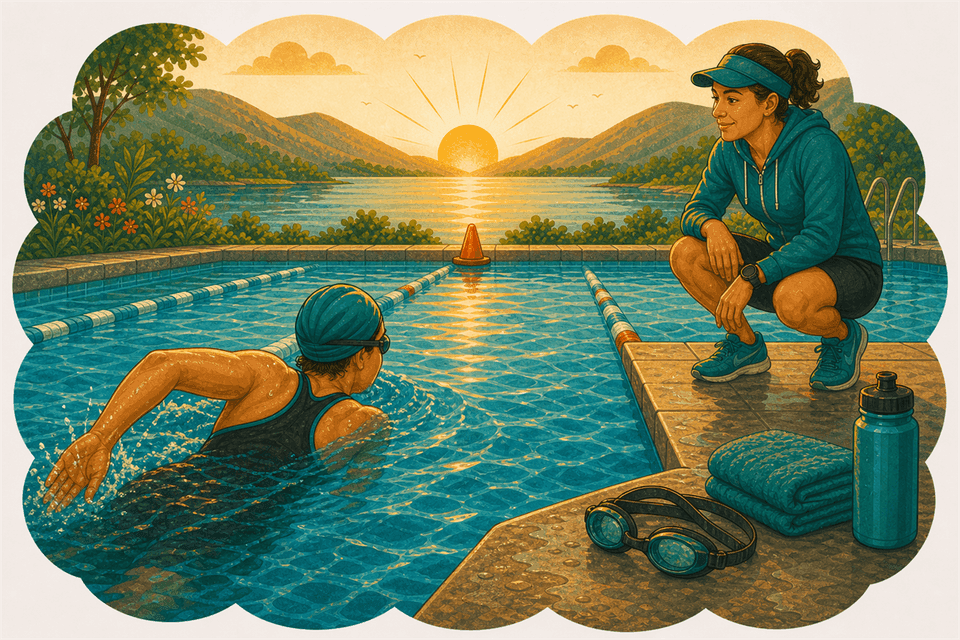
Sight a fixed object. Pick something at the end of your lane: a clock, a sign, a water bottle on the deck. Every few strokes, lift your eyes and find it. Your only job is to spot your target and drop back down smoothly. This builds the basic eye-lift habit.
Sight then breathe. Practice the full sequence as one unit. Eyes forward to find your object, then immediately roll to the side and breathe, then return your face to the water. Do this combo over and over until the two motions link together without you thinking about them.
Sight every six strokes and count. Now add rhythm. Count six strokes, sight, count six more, sight again. Counting keeps your sighting regular and predictable, which is exactly what you want in open water. You can adjust the number later, but six is a friendly starting point.
The eyes-closed straight test. Push off the wall and swim a few strokes with your eyes gently closed, then open them and see how straight you stayed. This shows you which way you naturally drift, so you know whether you tend to pull left or right. Knowing your drift makes your sighting smarter.
Sight on both sides. Practice sighting before you breathe to your left and before you breathe to your right. Open water is unpredictable, and being comfortable on both sides means glare, waves, or other swimmers will not throw you off.
How Often to Practice
You do not need a whole session devoted to this. Sprinkle sighting into the swims you are already doing. Pick one drill and add it to a few lengths during your warm-up or cool-down. A handful of focused minutes a couple of times a week adds up fast. Little and often beats one long, frustrating marathon session every time.
It Feels Awkward at First, and That Is Fine
The first few times you sight, expect it to feel clumsy. Your rhythm might stutter, you might take in a little water, and your eyes might pop up higher than you wanted. This is completely normal, and it happens to everyone. With a bit of repetition, the lift gets lower, the timing gets smoother, and the whole thing starts to disappear into your stroke. One day you will sight without even noticing you did it.
Sighting is also a quiet confidence builder. Knowing you can check your direction whenever you want makes the open water feel a lot less mysterious, which goes hand in hand with staying calm in open water.
You have got this, friend. Every small drill you do in the pool is making your first open-water swim calmer, straighter, and more fun. Take it one peek at a time, be patient with yourself, and come back to couchtotri.com whenever you want a hand with the next step. I am proud of you for showing up, and I will see you at the water.