5 min read · with Coach Finn
Treadmill vs Outdoor Running for Your First Triathlon
Part of Learning to Run From Zero, Without Getting Hurt
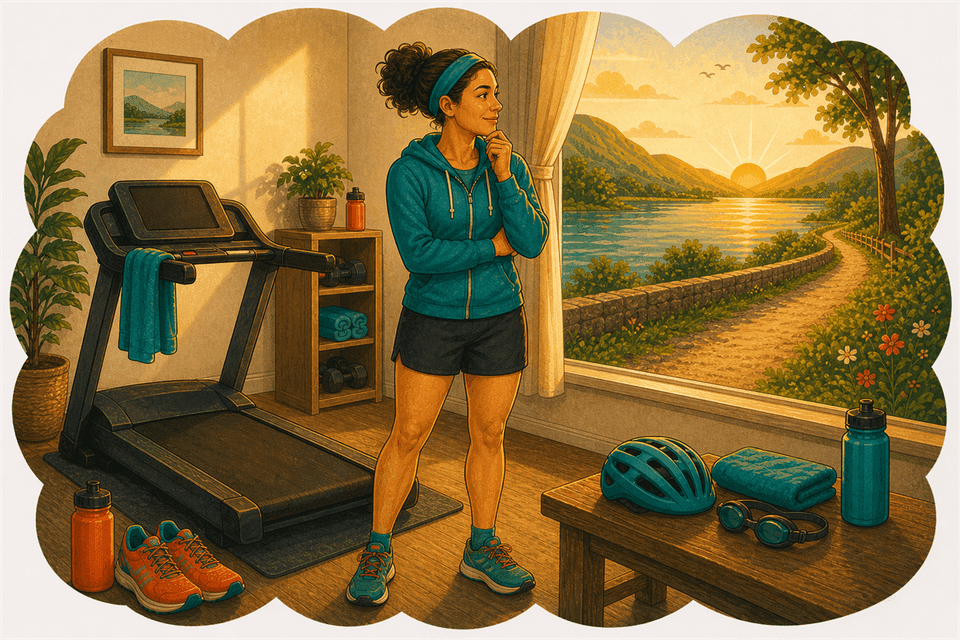
If you are standing in a gym looking at a treadmill, then glancing out the window at the sidewalk, wondering which one is going to get you ready for your first triathlon, take a breath. You are already asking a good question, and I have good news that will make the rest of this easier.
The Honest Truth First
Both count. Both build real, race-ready fitness. A mile of running is a mile of running, and your heart, lungs, and legs do not check whether the ground underneath them is a moving belt or a stretch of pavement. They just respond to the work you give them.
So here is the rule I want you to remember above everything else: the best option is the one you will actually do. If rain, darkness, or nerves keep you off the sidewalk, then a treadmill session you finish beats an outdoor run you skip every single time. And if the treadmill bores you into quitting, the open road wins. Do not let anyone make you feel that one is "real" training and the other is cheating. They are both real.
Let me walk you through the strengths and trade-offs of each, so you can choose with confidence.
The Treadmill: Your Weather-Proof Friend
There is a lot to love about the treadmill, especially when you are just starting out.
The pros:
- It is weather-proof. No heat, no ice, no downpour, no excuses. The session happens.
- The surface is softer. A treadmill belt has more give than concrete, which can be gentler on new-runner knees, shins, and ankles.
- You control the pace. Set a speed and it holds you there, which is wonderful for learning what easy actually feels like. Speaking of which, here is what pace your easy runs should actually be, because most beginners run too fast.
- It is safe and private. No traffic, no dark corners, no one watching. You can stop the instant you need to.
- It is perfect for run-walk. Punching in your intervals on the console makes structure effortless, which pairs beautifully with the best run-walk ratio for beginners.
One small but important tip: set the incline to 1 to 2 percent. Because the belt moves under you and there is no wind resistance, a flat treadmill is slightly easier than flat ground outside. A gentle incline closes that gap and makes your treadmill miles match your outdoor miles more honestly.
The cons:
- It can feel boring. Staring at a wall or a screen is not for everyone.
- It does not train terrain or balance. The belt is perfectly flat and perfectly even, so your stabilizing muscles get an easy day.
- Pace can feel different outside, which we will talk about in a moment.
Outdoor Running: The Real World
Now for the open road, the trail, the park loop, the place your race will actually happen.
The pros:
- It is the real thing. Your triathlon run will be outdoors, so outdoor running is the most specific practice you can get. This is called specificity, and it matters.
- You train terrain, wind, and feel. Small hills, a headwind, an uneven sidewalk, a corner you have to lean into: these are the exact things race day will hand you.
- It is free. No membership, no machine, just shoes and a door.
- Fresh air and a mental boost. A lot of beginners find that moving through the world, seeing trees and sky, lifts their mood in a way no screen can match.
The cons:
- Weather happens. Heat, cold, rain, and wind are all part of the deal, and heat in particular deserves respect. If you are training through a warm stretch, read up on running in heat without falling apart before you head out.
- The surfaces are harder. Pavement and concrete give back more impact than a belt does.
- Traffic and safety need a plan. Pick well-lit routes, run facing traffic where there are no sidewalks, and tell someone where you are going.
So Which One Should You Choose?
If you can, use both. Truly. The treadmill gives you a reliable, joint-friendly, weather-proof place to build your run-walk habit and your easy pace. The outdoors gives you the terrain, the air, and the real-world feel your race demands. Together they make you a more complete, more adaptable runner, and they keep training from getting stale.
But here is the one piece I will gently insist on: do at least some of your running outside before race day. Your Sprint or Olympic triathlon will be held outdoors, on real ground, with real weather, and you want your body and your nerves to have met those conditions before they count. Even one or two outdoor runs a week in the weeks leading up to your race will pay off enormously. You do not want the feel of pavement, or a slight hill, or a breeze in your face to be a surprise on the morning that matters most.
About That Pace Difference
Here is the thing nobody warns beginners about, so I will. Many people find that the pace they hold comfortably on a treadmill feels harder, or comes out slower, when they take it outside. That is completely normal and it does not mean you got worse or did something wrong.
Outdoor running adds wind resistance, real terrain, and the work of propelling yourself forward instead of letting a belt assist you. So if your outdoor pace looks a little slower than your treadmill pace, shrug and smile. Nothing is broken. Run by effort, not by the number, and let easy feel easy. Setting that 1 to 2 percent incline indoors helps shrink the gap, and over time your body learns both surfaces and the difference fades.
You Are Doing This Right
Whichever you reach for today, you are training. You are showing up, and showing up is the whole secret. Treadmill on a stormy Tuesday, sidewalk on a bright Saturday, both of them carrying you toward that finish line. Be proud of every mile, no matter what is under your feet.
You have got this, and you are not doing it alone. The rest of us at couchtotri.com are cheering you on, one run at a time. I will see you out there.