6 min read · with Coach Finn
What Is a Super Sprint, and Is It a Better First Race?
Part of How Long Does It Really Take to Go From the Couch to a Full Ironman?
If the word "triathlon" makes your stomach flip, I want you to take a breath. You are in exactly the right place, and I have good news. There is a version of this sport that was practically designed for someone standing right where you are. It is called the super-sprint, and it might be the kindest first race you could ask for. Let me walk you through it.
So What Exactly Is a Super-Sprint?
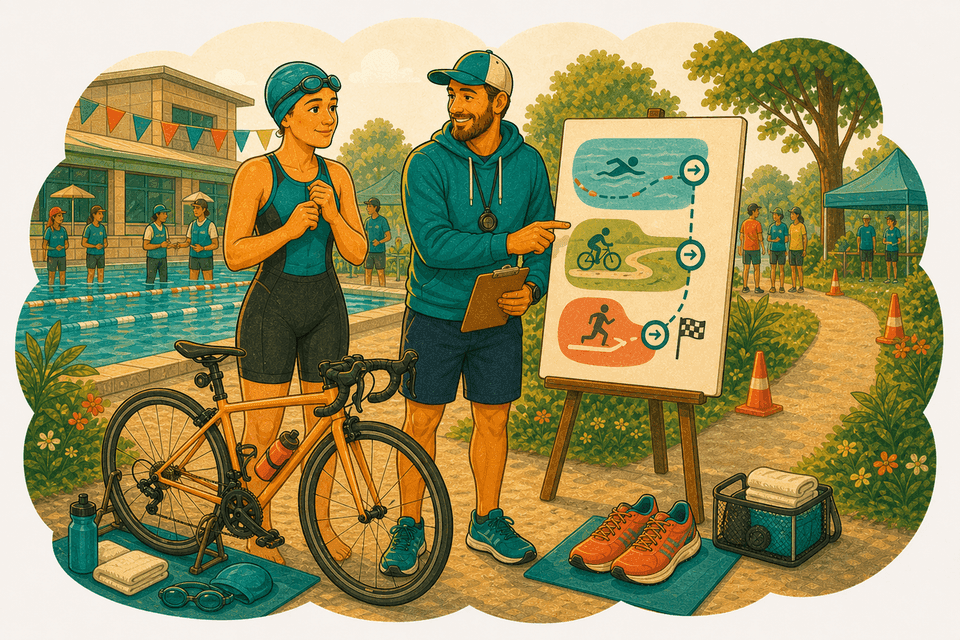
A super-sprint is simply the shortest standard triathlon distance out there. You still swim, then bike, then run, in that order, just like every other triathlon. The difference is that everything is scaled down to a friendly, doable size.
Distances do vary from race to race, so always read the event page carefully, but a very common super-sprint looks something like this:
- A 400m swim (often in a pool, which is lovely for beginners)
- A 10km bike
- A 2.5km run
Some super-sprints are even shorter than that. I have seen events with a 200m or 300m swim and a 1.5km run. The whole point is that the numbers stay small and approachable. If you can swim a few lengths, pedal a bike around your neighborhood, and walk or jog a lap of a park, you already have the raw ingredients for this.
It is worth saying clearly, because beginners often wonder: a super-sprint is a real triathlon. It absolutely counts. You swam, you biked, you ran, you crossed a finish line. Nobody gets to put an asterisk next to that, least of all you.
How Does It Compare to a Sprint?
You have probably heard of a "sprint" triathlon, and it is often described as the beginner distance. That is true, and a sprint is a wonderful goal. But a sprint is still a meaningful chunk of distance. A typical sprint is around a 750m swim, a 20km bike, and a 5km run.
Now look back at the super-sprint numbers. The swim is roughly half. The bike is about half. The run is half. Everything is gentler. For someone who finds even a sprint intimidating, that difference is not small. It can be the gap between "I could maybe do that someday" and "I could actually do that this season."
Think of it as the on-ramp before the sprint. You do not have to start on the highway. You get to ease in.
Why a Super-Sprint Makes Such a Great First Race
Here is where I get a little enthusiastic, because I have watched so many nervous beginners fall in love with this sport through a super-sprint. A few reasons it works so well:
It is short, so the whole thing feels manageable from the first day of training. You are not staring down months of grueling buildup. A sensible, gentle plan can get a healthy beginner ready in a reasonable stretch of time. If you are curious about how the longer journey unfolds, I wrote about how long it really takes to go from the couch all the way up, but you do not need to think that big yet. Today, we are just talking about your first short, friendly race.
The swim is often in a pool. This is a quiet game-changer for nervous beginners. A pool means a wall every 25 meters, a lane line to follow, a lifeguard nearby, and calm, clear water. So much of the fear around triathlon lives in open water, and a pool swim simply removes that worry.
The pressure is low. Nobody is expecting a super-sprint to be fast or fierce. It is a come-as-you-are sort of event. You will see all shapes, ages, and paces on that start line, and the crowd tends to be warm and encouraging.
You finish fresh, not flattened. Because the distances are short, most beginners cross the line tired but smiling, not wrecked. That feeling, finishing with something still in the tank, is the feeling that makes people sign up for a second race. It builds confidence instead of fear.
Who Is a Super-Sprint Really For?
Honestly? It is for more people than you would think. But it shines for a few folks in particular.
It is for the very nervous. If your inner voice has been saying "I am not an athlete" or "I could never," a super-sprint is your gentle answer to that voice. It is small enough to quiet the doubt.
It is for the time-crunched. Maybe you have a full work schedule, kids, a packed life, and the idea of training for hours every week feels impossible. The shorter distances mean shorter, more realistic training sessions. You can build fitness around your actual life.
It is for anyone just getting started. If you are coming off the couch, returning after years away, or simply brand new to swimming, biking, or running, this is your friendly front door into the sport.
If you want to think a step ahead about where things can go from here, the sprint vs olympic comparison is a nice read for later. And when you are ready to map out the timeline for the next step up, here is roughly how long couch to sprint tends to take. No rush, though. One finish line at a time.
A Gentle Word on Building Up
I always like to remind beginners to build slowly and kindly. Add a little distance at a time, give your body rest days, and listen to it when it asks for a break. A super-sprint does not require you to suddenly become a different person. It just asks you to show up consistently and let small efforts stack up over the weeks.
If anything ever feels off in a way that worries you, check in with a doctor before pushing on. That is not me being cautious for the sake of it. It is just good sense, and you only get the one body.
You Can Do This
Here is what I want you to hold onto. A super-sprint is short, it is welcoming, it is real, and it counts every bit as much as any other triathlon. It is the gentle on-ramp this sport should have advertised all along, and it is waiting for you whenever you are ready.
If you would like a hand getting there, we have a free beginner plan over at couchtotri.com that meets you exactly where you are today, no athletic background required. Come take a look, and let's get you to that first finish line together. I will be cheering for you the whole way.