5 min read · with Coach Finn
Triathlon With a Desk Job Body: Where to Start
Part of How Long Does It Really Take to Go From the Couch to a Full Ironman?
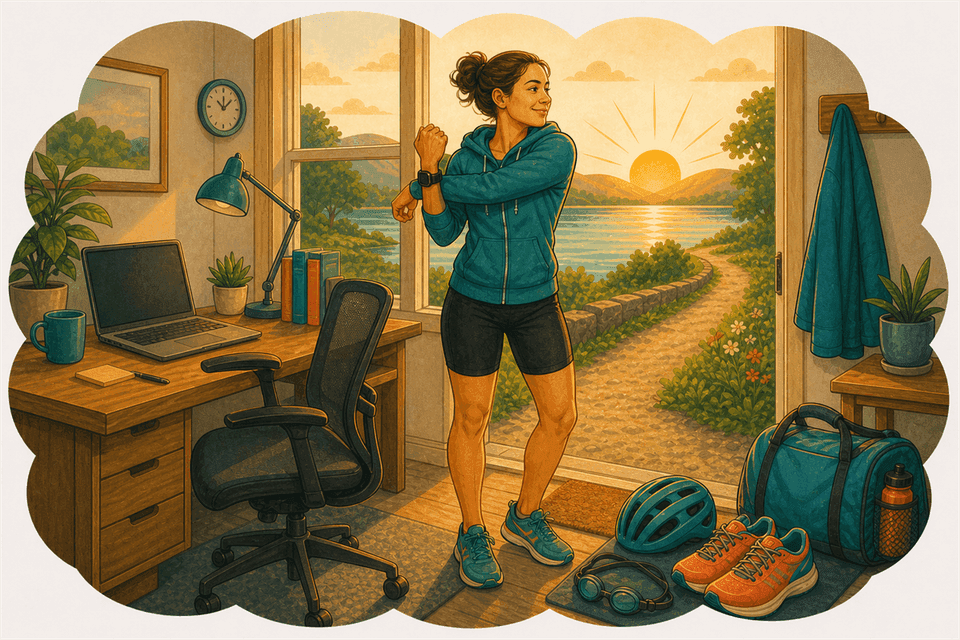
Hi, I am Coach Finn, and I want to start with the most important thing: a desk job body is not a problem to apologize for. It is the most common starting point I see, full stop. If your days are spent in a chair, your hips are tight, your back is stiff, and the words "aerobic base" sound like a foreign language, you are not behind. You are simply at the beginning, which is exactly where every triathlete once stood. Welcome. Let me show you where to start.
What Sitting All Day Actually Does
Let me be honest with you, because honesty is kinder than empty cheerleading. Sitting for forty hours a week shapes the body in predictable ways, and naming them helps you work with them instead of being surprised by them.
After years at a desk, your hip flexors and hamstrings tend to get tight from being folded into the same angle all day. Your glutes (the big engine muscles for running and cycling) often go quiet from underuse, and your deep core softens. Your upper back rounds forward and your neck creeps toward the screen, leaving things stiff up top. And because the chair asks so little of your heart and lungs, your aerobic base sits low.
Here is the good news hiding in that list: every single one of those is changeable. Muscles wake up. Tissue loosens. Hearts get stronger. The body you have today is not the body you will have in three months.
The Gentle Starting Plan
The biggest mistake I see from desk-job beginners is jumping straight into hard running because it feels like "real" training. Please do not. Your heart may be willing before your joints, tendons, and tight tissues are ready, and that mismatch is where injuries live.
Instead, start with the low-impact tools that let you build fitness without pounding:
- Walking. This is your foundation. Brisk walks, three or four times a week, twenty to thirty minutes. It builds your aerobic base while asking very little of stiff joints.
- Easy swimming. The water holds your weight, so it is gentle on everything. Even slow, splashy laps count. You are teaching your lungs and shoulders to work.
- Easy cycling. Low impact, low pressure. A stationary bike or a flat, calm ride lets your legs build endurance without impact.
When you do add running, add it gently, in small walk-then-run pieces rather than one long grind. If that idea is new to you, here is the best run-walk ratio for beginners to keep those first runs kind to your body.
The guiding rule for all of it: build very gradually. Add a little time or distance each week, not a lot. Slow growth is still growth, and it is the kind that lasts.
Mobility and Posture: Undoing the Chair
You do not need an hour of stretching. You need small, frequent kindnesses to the parts the chair tightened.
Gently open the hips with a few easy lunges or a calm figure-four stretch. Open the chest by rolling the shoulders back and reaching the arms wide, which counters that forward hunch. Five to ten minutes most days is plenty.
Just as helpful is what you do during the workday itself. Stand up every half hour or so. Walk to refill your water. Take a short lap around the office or the block. These tiny movements, repeated all day, do more to undo stiffness than one heroic session ever could. Your body wants to move. Give it frequent, gentle permission.
If you are wondering whether you also need to lift weights for any of this, I wrote a whole piece on whether you need strength training for triathlon so you can decide without the noise.
Build a Base Before You Chase Speed
I know it is tempting to want to feel fast. But for a desk-job beginner, speed is the last ingredient, not the first. Spend your early weeks and months building an aerobic base: easy efforts where you can still hold a conversation. This unglamorous, comfortable pace is what teaches your heart, lungs, and muscles to go longer.
Speed will come later, and it will come more easily, once that base is built. Rush it now and you mostly buy yourself soreness and frustration. Be patient with the easy stuff. It is doing more than it looks like it is doing.
A Quick, Sensible Note on Your Health
One practical thing before you lace up. If you have been very inactive for a long stretch, or you have any health concerns at all, please get a check-up with your doctor before you begin. It is a normal, smart first step, not a red flag, and most people get a simple green light. I am your coach, not your doctor, so let the person who knows your full history confirm you are clear to start. Then come back and let us get moving.
You Will Adapt Faster Than You Think
Here is the part I most want you to believe: the body adapts remarkably fast, often faster than your doubts expect. The walk that feels long in week one feels easy by week four. The hips that complained loosen. The breath that ran short steadies. Desk-bound bodies become triathlon bodies all the time, and yours can too.
If a quiet voice is telling you that you are simply too unfit for this, I gently disagree, and I made the case in full over here: feeling too out of shape for triathlon. Spoiler: you are not.
You do not have to become an Ironman. A Sprint triathlon, built slowly from walking and easy swimming and gentle cycling, is a genuinely life-changing goal for a desk-bound body. It can reshape not just your fitness but how you feel in your own skin every single day.
Start small. Start kind. Start where you are. I am right here cheering you on, and the whole community at couchtotri.com is starting alongside you. Let us go.