4 min read · with Coach Finn
First Triathlon Transition Checklist: What to Lay Out and What to Do
Part of The Swim, and the Fear
Transitions are not a test
The transition area can look chaotic from the outside. Bikes everywhere, towels on the ground, people in wetsuits, helmets, shoes, bottles, race belts, and a clock that keeps running.
Here is the calming truth: transition is just moving from one sport to the next with a plan.
You do not need to be fast in your first triathlon. You need to be calm, tidy, and safe. A slow transition where you remember everything beats a frantic one where you forget your helmet or run the wrong way.
This checklist is the beginner version. Print it, screenshot it, or walk through it at home before race week.
Before race morning
Practice this once before the race. You do not need a pool or a start line.
- Lay a towel on the floor.
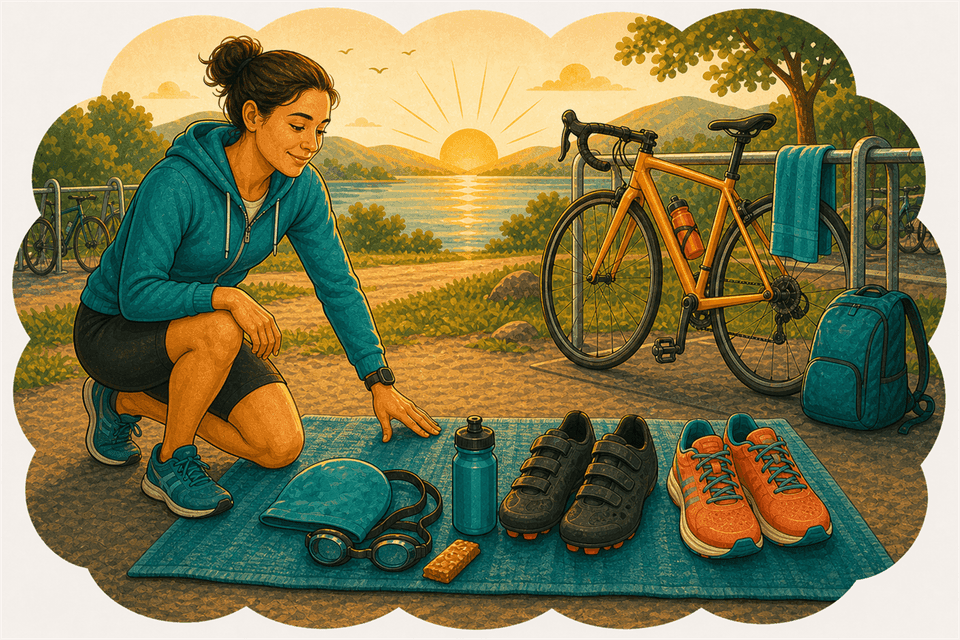
- Put your helmet, shoes, race belt, sunglasses, socks, and bottle around it.
- Walk through swim to bike.
- Walk through bike to run.
- Do it slowly first, then a little smoother.
The goal is not speed. The goal is that your hands know the order when your brain is excited.
If you want the bigger explanation of the two transitions, read T1 vs T2 for beginners.
What to put at your transition spot
Keep your setup small. Beginners often bring too much, then cannot find anything.
Lay these near your bike:
- Small towel.
- Helmet, straps open.
- Sunglasses if you use them.
- Bike shoes, or running shoes if you ride in those.
- Running shoes.
- Socks if you wear them.
- Race belt and number.
- Water bottle on the bike.
- Small snack or gel if you practiced it.
- Anti-chafe balm if you use it.
Your swim cap and timing chip usually come from the race. Keep the timing chip on your ankle unless race staff tells you otherwise.
Set up your spot
When you rack your bike, pause for one minute.
- Find your row.
- Find your rack spot.
- Pick a landmark, like a tree, flag, sign, fence, or the end of a rack.
- Walk from swim-in to your bike.
- Walk from your bike to bike-out.
- Walk from bike-in back to your bike.
- Walk from your bike to run-out.
That short walk removes a lot of race-day panic. You are teaching your brain, "I have been here before."
T1 checklist: swim to bike
When you come out of the water, keep the order simple.
- Go to your bike.
- Take off goggles and swim cap.
- If you wore a wetsuit, pull it down and step out carefully.
- Put on your helmet.
- Buckle the helmet before you touch the bike.
- Put on shoes.
- Put on sunglasses if you want them.
- Put on your race belt if your race wants the number visible on the bike. Usually the number faces back on the bike.
- Take your bike off the rack.
- Walk or jog the bike to the mount line.
- Get on only after the mount line.
The helmet rule matters. Helmet on and buckled before you touch the bike. Helmet stays on until the bike is racked again in T2.
T2 checklist: bike to run
T2 is usually calmer. Your job is to park the bike safely and start the run without overthinking it.
- Get off the bike before the dismount line.
- Walk or jog the bike back to your spot.
- Rack the bike.
- Only then unbuckle and remove your helmet.
- Change shoes if needed.
- Spin your race number to the front.
- Grab your hat, sunglasses, or small fuel if you planned them.
- Head to run-out.
Your legs may feel strange for the first few minutes. That is normal. It is why beginner plans include brick workouts.
What not to do in transition
Avoid these beginner traps:
- Do not ride your bike inside transition.
- Do not touch your bike before your helmet is buckled.
- Do not unbuckle your helmet before your bike is racked.
- Do not bring a giant bag to your spot unless the race allows it.
- Do not try new shoes, socks, pedals, nutrition, or clothing on race day.
- Do not copy the fastest person nearby. They are not running your race.
Calm beats clever.
The tiny rehearsal that changes everything
The week before your race, do this at home:
- Towel down.
- Helmet open.
- Shoes ready.
- Walk in as if you just finished the swim.
- Helmet on, buckle, shoes, pretend bike out.
- Pretend bike back in, rack, helmet off, run shoes, go.
Repeat it five times.
That is enough to make race morning feel familiar.
The bottom line
Your first transition does not need to be fast. It needs to be safe, calm, and repeatable.
Lay out less. Walk the flow. Follow the helmet rule. Move through T1 and T2 in the same order every time.
Coach Finn builds this kind of race-readiness into your plan, not just the workouts. When you start free with Finn, the First Race Readiness Path helps you handle the swim fear, gear, transitions, fueling, and race week one small step at a time.