6 min read · with Coach Finn
Duathlon vs Triathlon: A No-Swim Way to Start?
Part of The Swim, and the Fear
If the swim is the thing standing between you and your first race, I want you to take a deep breath right now. You are not stuck. You are not disqualified from this sport. There is a whole category of multisport racing waiting for you that does not involve getting in the water at all, and it might be the perfect on-ramp while you sort out the rest. Let me walk you through it.
So What Exactly Is a Duathlon?
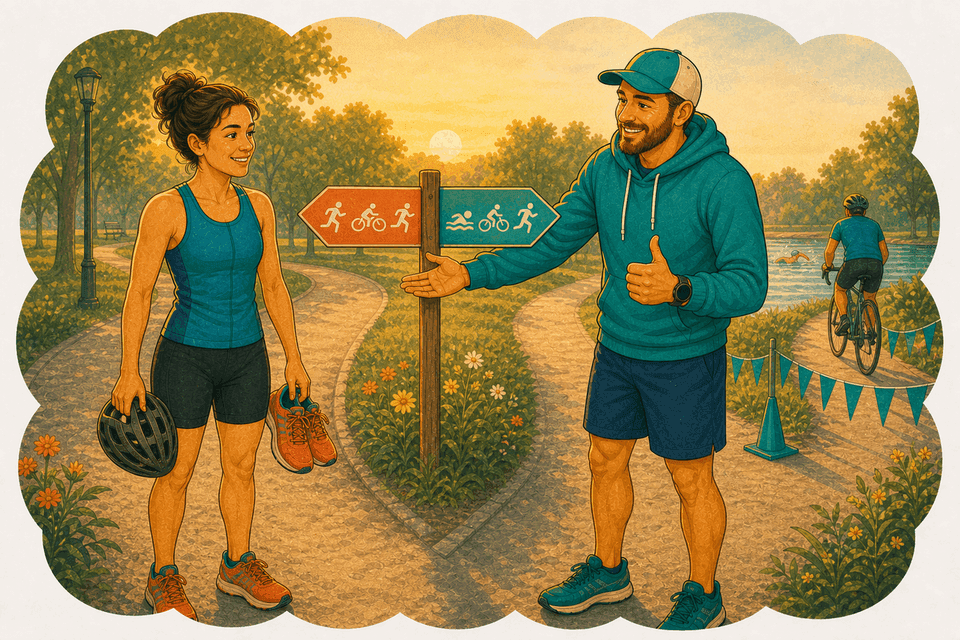
A duathlon is a multisport race built from two activities instead of three. The order goes run, bike, run. You start on your feet, you move to the bike, then you finish back on your feet. No swimming. None.
A common beginner-friendly duathlon might look something like a 2 kilometer run, a 10 kilometer bike, and a 1 kilometer run to close it out. Distances vary a lot by event, so always check the specific race, but the shape is always the same. Run, then bike, then run.
Just like in a triathlon, there are transitions. The spot where you rack your bike and swap your gear is called the transition area, and you will move through it twice. Once when you come off that first run and clip into the bike, and once when you come off the bike and head out for the final run. People who do triathlons call these T1 and T2, and duathlon uses the exact same setup. So you are still learning the real rhythm of multisport racing. You are just doing it without the part that scares you.
How a Duathlon Differs From a Triathlon
The headline difference is obvious. A triathlon is swim, bike, run. A duathlon is run, bike, run. Swap the swim for an extra run and you have made the jump.
That single change does a few helpful things for a nervous beginner. You skip open water entirely, which for a lot of people removes the single biggest source of pre-race dread. You also skip the gear and logistics of swimming, so no wetsuit decisions, no goggles fogging up, no figuring out how to get from soaking wet to pedaling a bike. And you get to start the race doing something most of us already know how to do, which is put one foot in front of the other.
The bike and the transitions are essentially the same experience you would get in a triathlon. So when people ask me whether a duathlon counts as real training for triathlon, my answer is yes, absolutely. Two of the three disciplines carry straight over, and so does the whole mental game of moving between them.
Why a Duathlon Is a Great No-Swim On-Ramp
Here is the honest truth about why I love duathlons for beginners. They let you start now.
So many people put off this sport for years because they are waiting to feel ready in the water. I understand that completely, and I have written before about the swim, and the fear because it deserves real respect, not a pep talk that pretends it away. But waiting to be a confident swimmer before you ever pin on a race number means waiting a long time, and sometimes it means never starting at all.
A duathlon hands you a door you can walk through today. You get to experience a start line. You get to learn how it feels to push the pace on tired legs, to rack a bike, to manage your nerves, to cross a finish line with a medal and a story. That experience is real and it is yours, swim or no swim. If you have been telling yourself you cannot do a triathlon because you cannot swim yet, I would gently point you toward this idea too, and to I can't swim but want to do a triathlon, because the door is wider than you think.
And please hear me on the build-up. Go gently. You do not have to run the whole thing. Run-walk is a completely legitimate, smart way to cover the running portions, especially that second run when your legs feel like someone swapped them out for sandbags. Walk the hills, walk the aid stations, jog the flats. Finishing happy beats finishing fast every single time.
The Honest Tradeoff
I promised you honesty, so here it is. A duathlon is not a soft option, and it is not without its own quirks.
The biggest one is your legs. Running, then biking, then running again asks a lot of the same muscles twice, and that second run is famous for feeling heavy and strange. In a triathlon, the swim warms you up without pounding your legs, so you arrive at the run with fresher quads. Duathletes do not get that gift. This is exactly why a gentle, gradual build matters, and why run-walk is your friend. Give your body time to get used to running on already-tired legs, and do not jump up in distance too quickly.
The other tradeoff is simpler. If you only ever do duathlons, you never build your swimming. And swimming is a wonderful, low-impact, lifelong skill that opens up the whole world of triathlon down the road. So I do not want you to use the duathlon as a permanent way to dodge the water. I want you to use it as a beginning.
Using a Duathlon as a Stepping Stone
Here is how I would love you to think about it. Sign up for a duathlon. Let it give you your first taste of racing and that hard-won confidence. And then, alongside your run and bike training, start learning to swim. No pressure, no rush. Just a few quiet sessions in a pool, getting comfortable, one short length at a time.
That way your duathlon is not a detour. It is the first chapter. You race now, you build skills as you go, and when you are ready, you add the swim and step up to a triathlon as someone who already knows the rhythm of the sport. When that day comes and you start eyeing your first triathlon distance, sprint vs Olympic for your first triathlon is a good next read to help you choose.
Plenty of lifelong triathletes started exactly here, with a run-bike-run and a promise to themselves to learn the water later. There is nothing lesser about it. It is just a different, kinder order of operations.
You Are Allowed to Start Here
So is a duathlon a real, legitimate way into this sport? Yes. Without a single asterisk. Starting with run-bike-run while you learn to swim is not cutting a corner. It is showing up, which is the hardest part, and being honest about where you are today.
Pick a friendly local duathlon, build toward it gently, walk whenever you need to, and let yourself enjoy the whole thing. And when you want a no-stress, beginner-shaped way to train for it, I would love to get you started with a free plan over at couchtotri.com. The water will still be there when you are ready. For now, lace up. I am proud of you already.