7 min read · with Coach Finn
Gasping After 25 Meters of Freestyle? Here Is Why, and the Fix
Part of The Swim, and the Fear
First, you are not broken
If you can walk, jog, ride a bike, or lift weights, but one length of freestyle leaves you gasping at the wall, it feels confusing.
You think, "How can I be this out of shape?"
Let me take that weight off your shoulders.
Gasping after 25 meters usually does not mean you are hopelessly unfit. It usually means your breathing, body position, and effort are all fighting each other at once.
Swimming punishes tension. It punishes breath-holding. It punishes trying harder before you can move calmly. So a beginner can spend enormous energy going nowhere, then blame their fitness when the real problem is technique and panic.
This is fixable.
The usual cause: you are holding your breath
Most new freestyle swimmers do some version of this:
They take a huge breath at the wall, put their face in, hold it, kick hard, pull hard, then try to grab another breath when the pressure in their chest is already loud.
By the time they turn to breathe, the body is not asking calmly for air. It is demanding it.
That demand feels like panic.
The fix is not a bigger inhale. It is a steadier exhale.
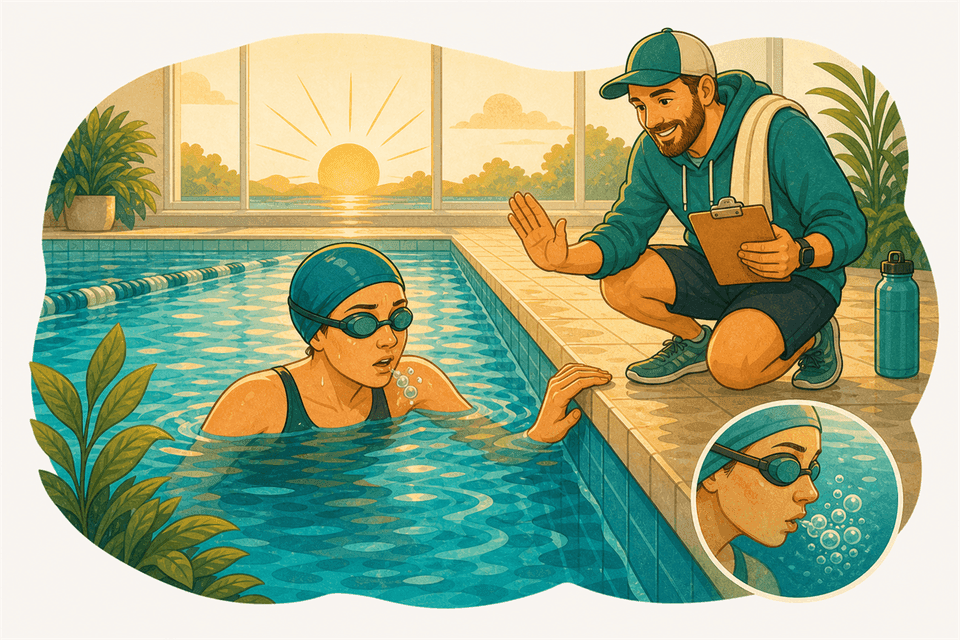
When your face is in the water, you should be letting air out slowly almost the whole time. Bubbles should be gentle and continuous. Then, when you turn to breathe, you are not trying to empty and fill your lungs in one desperate second. You are only sipping air in after you have already breathed out.
That one change can make freestyle feel completely different.
The second cause: your head is lifting
When you feel short of air, your instincts tell you to lift your head.
In the water, that instinct works against you.
When your head lifts, your hips and legs drop. Now your body is angled like a plow. You are pushing more water, dragging more leg, and working much harder. More work means more air hunger, which makes you lift your head again.
That is the spiral.
Instead, your head needs to stay low. Think eyes down, neck long, one goggle still in the water when you breathe. You are not popping up to breathe. You are rolling gently to the side.
It feels strange at first because it is the opposite of land instinct. In water, calm breathing comes from staying lower, not higher.
The third cause: you are sprinting by accident
Beginners often swim every length like a tiny emergency.
Fast kick. Hard pull. Tight jaw. Stiff neck. Everything switched on.
Then the wall arrives and they are cooked.
A good first freestyle length should feel almost embarrassingly slow. You should be able to stop at the wall and think, "I could do that again after a rest." Not "I survived."
The pace that feels too slow is usually the pace that teaches you.
The fourth cause: your kick is spending all your air
Your legs are big muscles. Big muscles use oxygen.
If you kick hard from the knees, splash a lot, and try to muscle yourself across the pool, you can burn through your air before your arms have done much useful work.
For beginner triathlon swimming, the kick is not an engine. It is a balance tool.
Keep it small. Loose ankles. Gentle movement from the hips. Think "quiet feet." If the water is boiling behind you, soften.
You are saving your legs for the bike and run anyway.
The fix: the 6-3-6 breathing reset
This drill is simple, and it works because it separates breathing from panic.
Do it in a pool where you can stand or near a wall.
Step 1: Six bubble breaths
Stand in the shallow end. Put your face in and blow bubbles slowly for three seconds. Lift and breathe in. Repeat six times.
Do not hold your breath. Do not blast the air out. Slow bubbles.
Step 2: Three calm glides
Push gently from the wall with your arms out front. Face down. Bubbles out. Glide until you need air, then stand.
Do that three times. No arms yet. No race. Just body position and breathing.
Step 3: Six easy strokes
Push off, take six very easy freestyle strokes, breathing out any time your face is in the water. When you turn for air, keep it low and gentle. Stop after six strokes, even if you could keep going.
Repeat this pattern for 10 minutes:
- six bubble breaths
- three glides
- six easy strokes
You are teaching your body that breathing is not an emergency. You are also stopping before the panic spiral starts. That is how you rebuild the association.
How to build from 6 strokes to 25 meters
Once six strokes feels calm, do not jump straight to all-out lengths.
Use a ladder:
- 6 strokes, rest
- 8 strokes, rest
- 10 strokes, rest
- half a length, rest
- three-quarters of a length, rest
- one length, rest as long as needed
Only move up when the current rung feels calm. If you reach a rung and the gasping comes back, step down. That is not failure. That is information.
The goal is not to force 25 meters once. The goal is to make 25 meters repeatable.
What should breathing rhythm be?
There is no single magic rhythm.
Many beginners do well breathing every two strokes at first, always to the same side, because it gives them frequent air and fewer things to coordinate. Later, you can learn both sides. Bilateral breathing is useful, but it is not more important than staying calm.
If breathing every three strokes makes you feel starved, breathe every two. If one side feels much easier, use that side while you build confidence.
We can refine later. First we make the swim safe and repeatable.
When gasping is not just technique
Most one-length gasping is technique and tension. But not all breathing distress belongs in a swim drill.
Stop and get medical advice if you have chest pain, pressure, faintness, dizziness, wheezing that is unusual for you, blue lips, racing heart that feels wrong, or shortness of breath that does not settle quickly with rest.
Training should challenge you sometimes. It should not feel dangerous.
If you are unsure, treat that uncertainty with respect. A cleared, calm athlete can train. A frightened athlete ignoring warning signs cannot train well.
FAQ
Should I breathe through my nose or mouth?
Inhale through your mouth when you turn to breathe. Exhale into the water through your nose, mouth, or both. Many beginners like a soft hum because it keeps the exhale steady.
Should I use a snorkel?
A front snorkel can be useful later for body-position drills, but do not use it to avoid learning breath timing forever. Triathlon swimming needs a real breathing pattern. Use tools to teach, not to hide from the skill.
Should I swim more lengths to build fitness?
Not yet. More tired, messy lengths can teach the wrong pattern. First make short repeats calm. Then add distance.
Your next swim
At your next pool session, do not chase a full length right away.
Do the 6-3-6 reset for 10 minutes. Then try one calm half length. If it stays easy, try a full length. If it gets ragged, stop and return to bubbles and glides.
That is not going backward. That is coaching.
You are not trying to prove you can suffer through 25 meters. You are teaching your body how to breathe through it.
Slow bubbles. Low head. Quiet kick. Easy strokes.
That is the fix.
As always, consult a healthcare professional before starting a new exercise program if you have a medical condition or symptom that concerns you.