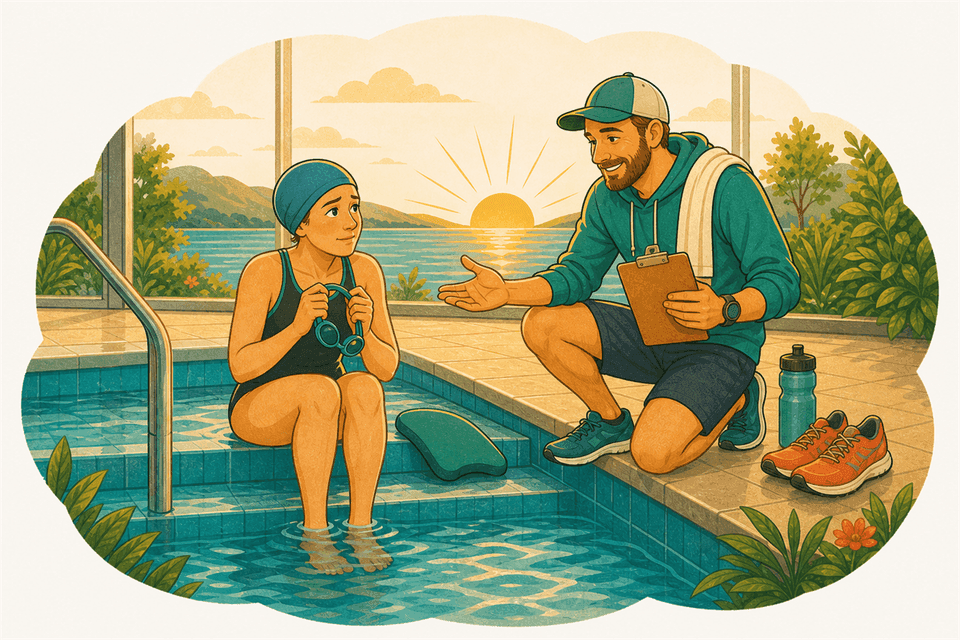
6 min read · with Coach Finn
I Can't Swim But Want to Do a Triathlon. Can I Still Start?
Part of The Swim, and the Fear
The honest answer
Yes, you can start.
Not race tomorrow. Not jump into open water this weekend. Not pretend the swim is no big deal. But start? Absolutely.
If you cannot swim freestyle yet, you are not disqualified from becoming a triathlete. You are simply starting at the real beginning. That is different.
Most triathlon advice skips this part. It assumes you can already swim a few lengths, breathe to the side, and stay calm in deep water. Then it tells you to add bike miles and run intervals. For a lot of beginners, that is like being handed chapter seven of a book when you still need chapter one.
So here is chapter one: your first goal is not speed. It is not distance. It is not even freestyle.
Your first goal is calm.
Why the swim feels like a locked door
Water fear feels personal, but it is not a personality flaw. It is your nervous system doing a very old job.
When your face goes under and you are not sure what to do next, your body can read that as danger. Your shoulders tense. Your breathing gets short. You lift your head. Your hips drop. You start fighting the water instead of floating in it. Then you feel more tired, which makes you more afraid, which makes you fight harder.
That spiral can happen to a very fit person. It can happen to a runner, a cyclist, a lifter, or someone who hikes every weekend. Swim panic is not proof that you are out of shape. It is usually proof that you have not yet learned the small water skills that make your body feel safe.
That is good news. Skills can be taught.
What you should not do first
Do not sign up for the longest race you can find and hope fear will motivate you.
Do not go to a pool, shove off the wall, and try to survive one length by force.
Do not start in open water.
Do not let anyone tell you to "just relax" as if relaxation is a switch you forgot to flip.
Relaxation in water is trained. You build it the same way you build fitness: with small, repeatable steps that are easy enough to come back to.
If you have been sedentary, have a heart or breathing condition, have chest pain, fainting, unusual shortness of breath, dizziness, or any medical concern, get medical clearance before you start a training plan. That is not a delay. That is how you make the start line safer.
The first four milestones
Forget the whole race for a minute. Here is the real swim path.
1. Stand calmly in shallow water
This sounds too small. It is not.
Go to a pool where you can stand easily. Walk around. Put your shoulders under. Splash your own face. Notice that you can stop whenever you want. Your brain learns safety through repetition, not through speeches.
If standing in the shallow end is enough for day one, that is a win.
2. Put your face in and breathe out
This is the first true swim skill.
Take a normal breath. Put your face in the water. Hum or blow bubbles out slowly. Lift your face and breathe in. Repeat.
The point is not to hold your breath longer. The point is to stop holding your breath at all. When you breathe out steadily underwater, pressure does not build in your chest, and the panic alarm has less to grab.
3. Float where you can stand
Hold the wall or stay in water shallow enough to put your feet down. Put your face in, let your legs rise, and feel the water hold you.
You are not trying to be brave. You are collecting evidence.
The evidence is simple: with air in your lungs and your body relaxed, the water helps you. It is not just something you have to fight.
4. Glide before you stroke
Push gently from the wall and glide with your arms out in front, face down, bubbles out. Stand up when you need to.
This teaches body position before effort. That matters because most beginners get exhausted by poor position, not by lack of heart. A long, quiet body moves through water more easily than a tense, head-up body.
Your first-week drill: the five-minute calm ladder
Do this once or twice this week in a pool where you can stand.
- Stand in the shallow end for one minute and let your shoulders drop.
- Splash your cheeks, forehead, and the back of your neck.
- Put your mouth in the water and blow bubbles for five easy breaths.
- Put your whole face in and hum bubbles for five easy breaths.
- Hold the wall, float for three seconds, then stand up.
- Repeat the float three to five times.
Stop while it still feels manageable. That part matters. You are teaching your body that water practice ends calmly, not in a fight.
When do you become ready for a race?
For most true beginners, the first race target should be a sprint triathlon, not a half Ironman or full Ironman. A sprint is still real. It is still swim, bike, run. It still gives you the finish-line moment. It also gives your body and your confidence a sane first mountain to climb.
The swim target will depend on the race, but the path is usually:
- calm face-in-water breathing
- relaxed floating
- 25 meters without panic
- 50 meters with rest
- 100 meters with control
- several hundred meters relaxed in the pool
- supervised open-water practice
- race rehearsal
Notice what is missing from that list: panic, shame, and proving yourself by suffering.
You do not earn triathlon by scaring yourself. You earn it by practicing until the scary thing becomes familiar.
FAQ
Should I get adult swim lessons?
Yes, if you can. A good adult learn-to-swim coach is worth it, especially if you panic, sink, or cannot coordinate breathing. You do not need a fancy triathlon coach yet. You need someone patient who understands adults and starts with comfort, breathing, and balance.
Should I use a kickboard or fins?
They can help later, but do not let equipment become a way to skip calm. The first skills are face in, bubbles out, float, and glide. Add tools only if they support those skills.
What if I am embarrassed at the pool?
Most people at the pool are thinking about themselves. The confident swimmer in the next lane may not notice you at all. If they do, they are more likely to respect you for learning than judge you for starting.
Pick a quiet lane time. Stay in the shallow area. Give yourself a simple assignment. You do not need to look like a swimmer to become one.
The next step
Your next step is not to become a swimmer this week.
Your next step is to make the water a little less strange.
That is enough. That is how this starts. One calm breath, bubbles out, in water where you can stand.
When that becomes boring, we build the next rung.
As always, consult a healthcare professional before starting a new exercise program if you have a medical condition or symptom that concerns you.