5 min read · with Coach Finn
How Do I Get a Wetsuit Off Fast in Transition?
Part of The Fourth Discipline: Brick Workouts and Transitions
Picture it: you just finished your first open water swim, you are jogging up the beach feeling like a hero, and then you try to take your wetsuit off. Suddenly you are hopping on one foot, tugging at your ankle, and quietly wishing you had practiced this exactly one time before race day. If that is you, welcome. You are in very good company, and this is one of the most fixable parts of your whole race.
Let me walk you through how to get a wetsuit off quickly, calmly, and without the circus act.
Why Wetsuits Fight Back
Wetsuits are designed to hug you. They are snug on purpose so cold water cannot flush through and chill you. Add water to that tight rubber and you get suction, the same way a wet glove clings to your hand. The neoprene grips your skin, especially at the narrow points like your wrists and ankles, and it does not want to let go.
So the suit is not broken and you are not doing it wrong. It is just doing its job a little too well. Your goal is to break that suction and roll the suit off, not to overpower it with brute strength.
Start Before You Even Reach Transition
The fastest wetsuit removal begins while you are still moving. As soon as you stand up out of the water and find your footing, reach back and pull the zipper cord down. Most beginner suits unzip from top to bottom with a long cord at the neck.
Then, as you walk or jog toward your bike, peel the top half down. Pull your arms out one at a time and roll the upper part of the suit down to your waist. By the time you reach your spot, you are already halfway done and you have used time that would otherwise be spent standing still. If you want a fuller picture of what happens in that area of the course, here is a friendly primer on moving through T1 and T2 transitions.
A Little Slip Goes a Long Way
Here is a small trick that makes a big difference: anti-chafe or body glide. Before you put the suit on, rub a generous amount around your ankles, wrists, and calves. This gives the neoprene something slick to slide against, so when you peel later, the suit glances right off instead of catching on your skin.
A few notes. Use a wetsuit-safe lubricant, because some petroleum products can damage neoprene over time. And think about what to wear under your wetsuit, since the right base layer also helps things slide and keeps you comfortable on the bike and run.
The Step-by-Step Technique
Once you are at your transition spot, here is the simple sequence:
- Finish unzipping if you have not already, and confirm the suit is peeled down to your waist.
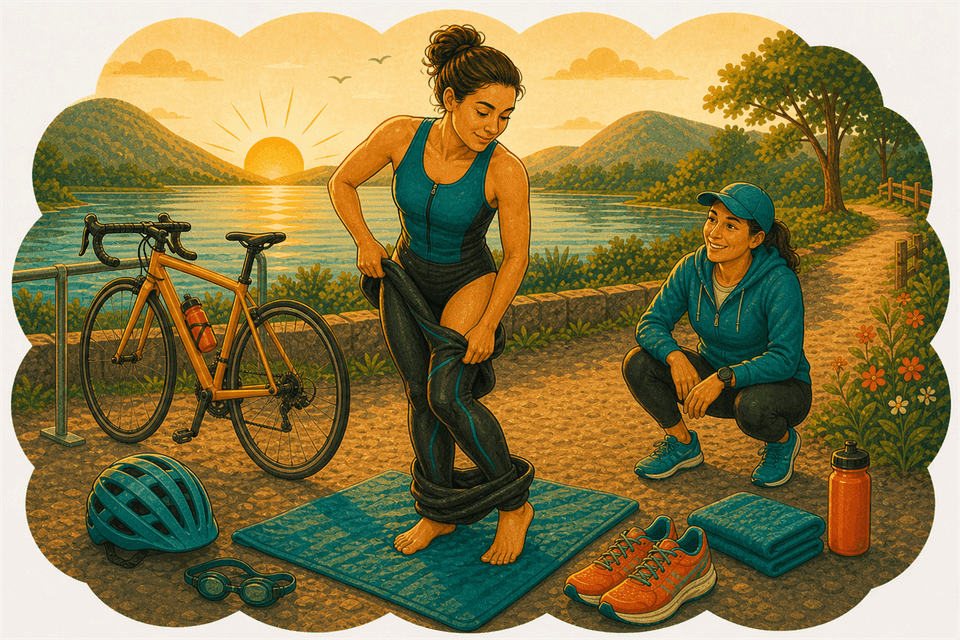
- Push the suit down over your hips and thighs with both hands, rolling it inside out as you go. Inside out is the magic word, because a rolled cuff slides easier than a flat one.
- Get it down to your ankles. This is where most people get stuck, so slow down here on purpose.
- Step on the leg fabric of one side with your other foot, then pull that leg straight up and out. Let the ground hold the suit while you lift free.
- Repeat with the second leg. If stepping feels awkward, sit down, grab the ankle cuff, and pull each foot out one at a time.
Notice what is not on that list: yanking. Pulling hard on a stuck ankle usually just tightens the grip and tips you over. Steady, rolling pressure wins.
The Ankle Is the Boss Level
If you remember one thing, remember this: the ankle is the sticking point, every single time. It is the narrowest part of the suit and the last thing to come free, so plan for it instead of being surprised by it.
This is exactly why the body glide and the step-on-the-fabric move matter so much. When you expect the ankle to fight you, you stay calm, you keep your weight balanced, and you do not end up sitting in the grass laughing at yourself (though honestly, that is fine too).
Practice Before It Counts
You would be amazed how much smoother this gets after just three or four tries. Practice at home on your living room floor, or build it into a training session after an open water swim. Wet the suit, peel it down, roll it off, and time yourself if you like. Your hands will learn the motion so that on race morning, your body already knows what to do while your brain is busy being nervous.
If you are still deciding on a suit, this guide on renting or buying a wetsuit can help you land on the right option before you start practicing.
It Is Okay to Be Slow
Here is the truth that takes the pressure off: transitions are not where beginner races are won. Whether you are doing a Sprint, an Olympic, a 70.3, or dreaming toward an Ironman one day, a few extra seconds in transition will not make or break your day. The swim, the bike, and the run are where your race lives. Transition is just the calm hallway between rooms.
So move with purpose, but do not rush into a tangle. A smooth, steady removal beats a frantic one almost every time. And yes, everyone, from first-timers to seasoned athletes, has had at least one wrestling match with a wetsuit. Looking a little silly is basically part of the sport. We have all hopped around on one foot. You are in the club now.
You Have Got This
Take a breath, give your ankles a little glide, practice the peel a couple of times, and trust that this gets easier fast. You do not need to be smooth or graceful, you just need to keep moving forward, and that is something you already know how to do. For more friendly, no-pressure guides made for brand new triathletes, come spend some time with us at couchtotri.com. We are cheering for you, wetsuit wrestling matches and all.