5 min read · with Coach Finn
Where Do I Go to the Bathroom on Race Day?
Part of Race Week and Race Day: A Calm Walk to the Start Line
Let me guess. You have a training plan, a swim cap, and a quiet little question rattling around your head that you have not quite worked up the nerve to ask anyone. It goes something like, "wait, where exactly do I go to the bathroom on race day?" Friend, I am so glad you are here, because this is one of the most common worries in all of beginner triathlon, and almost nobody says it out loud. So let me say it for both of us. You will be fine. There are toilets. Let me walk you through all of it.
Yes, There Are Toilets (Lots of Them)
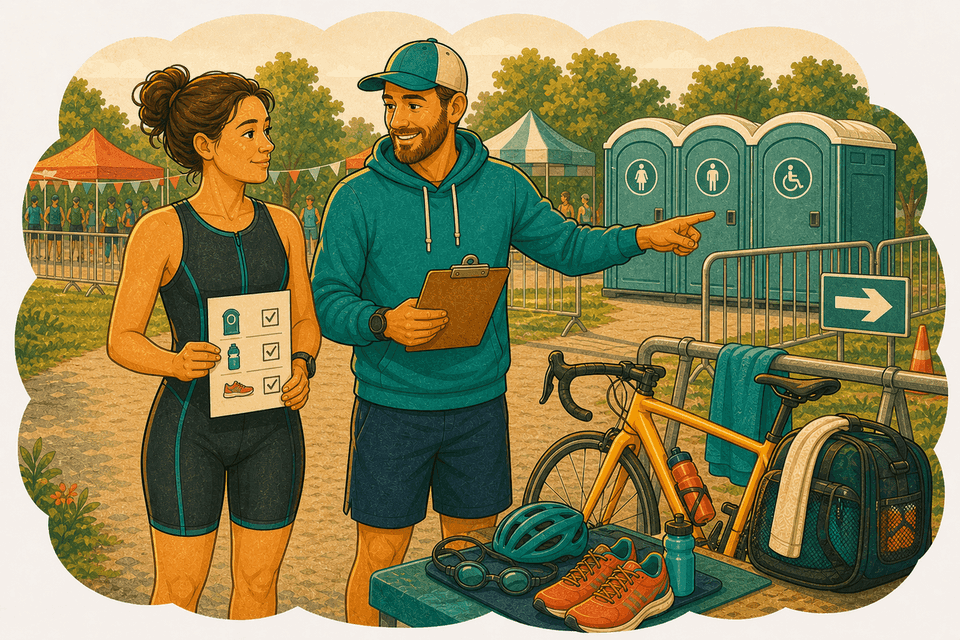
First, the good news. Every legitimate triathlon has bathrooms. Usually that means a long row of porta-potties set up near the transition area, and sometimes permanent restrooms at the park, beach, or rec center hosting the event. Race directors know that hundreds of nervous humans are about to arrive with coffee in hand. They plan for it.
The catch is simple. You are not the only one who needs to go, and everyone tends to need to go in the same thirty-minute window right before the start. So the porta-potties are there, but the lines can get long. That is the entire problem in a nutshell, and the entire solution is just two words. Go early.
When you arrive and get your transition area set up, scout where the bathrooms are. Knowing exactly where to walk later, when your nerves are buzzing, is a small thing that brings a surprising amount of calm.
The Nervous-Bladder Thing Is Completely Normal
Here is something nobody warns you about. On race morning, you may feel like you need to go to the bathroom roughly every nine minutes, whether you actually do or not. This is not a sign that something is wrong with you. It is adrenaline. Your body is excited and a little wired, and a jumpy bladder is one of the classic ways that shows up.
So if you find yourself making your third trip to the porta-potty before the swim even starts, congratulations, you are a completely normal triathlete. Veterans do it too. They have just stopped being embarrassed about it. The nerves are part of the experience, not a flaw in your preparation. If you want a fuller picture of the jitters waiting for you that morning, I walk through the whole thing in race week and race day.
Timing Your Morning So You Are Not Sprinting to the Line
Let me give you a loose rhythm for the morning, because good timing is what keeps the bathroom question from becoming a bathroom crisis.
Have your coffee and your small breakfast early, ideally a couple of hours before your start. That gives your system time to do its thing at home or at the hotel, on your own terms, with a door that locks and a roll of real toilet paper. This one habit solves most of the problem before you ever reach the venue.
Arrive at the race site with plenty of cushion. You want time to park, set up transition, and still wander to the porta-potty line without a stopwatch running in your head.
Then plan one final bathroom stop into your pre-race routine. Here is the part people underestimate. That last line can be twenty or thirty people deep, and it can move slowly. Budget fifteen or twenty minutes for it. Get in line earlier than feels necessary. If you come out with time to spare, wonderful, you get to breathe and watch the sunrise. If you cut it close, you will feel that stress in your shoulders all the way through the swim.
What If I Need to Go During the Race?
This is the question behind the question, so let me answer it plainly and kindly.
If you are doing a longer race, there are porta-potties out on the course, usually at the aid stations along the run and sometimes the bike. You are completely allowed to stop and use them. It costs you a couple of minutes, and not a single person who matters will care. For a beginner at a shorter sprint distance, you very likely will not need anything on course at all, because the whole thing is over before your body gets around to asking.
Now, you may have heard whispers that experienced racers sometimes, ahem, do not stop. That they handle things on the bike or in the water and keep moving. That is a real thing in the sport, and I am not going to pretend otherwise. But here is my honest coaching advice. You do not need to think about any of that. Not now, maybe not ever. Stopping at a toilet is a perfectly good plan, and it is the one I would point any first-timer toward. File the rest under "things to be amused by later."
If a worry like this is making you wonder whether you are cut out for this at all, you are not alone in that either, and I wrote about it in will I finish last in a triathlon.
Drink Smart, But Do Not Drown Yourself
One last practical note, because it ties the whole bathroom question together. In the days before your race, stay nicely hydrated. Sip water, keep your urine pale, and do not arrive parched.
But please do not overdo it on race morning by chugging an enormous bottle of water "just to be safe." That mostly guarantees one more frantic trip to the porta-potty line and, in rare cases, can actually leave you feeling worse rather than better. Steady sips beat panic gulping every time. Your body is better at this than your nerves give it credit for.
If you are still in the earlier planning stages and these logistics feel like a lot, that is okay too. Start with the basics over in I registered for a triathlon, now what, and let the small stuff come together one piece at a time.
So there it is, the most normal worry in the world, answered. There are toilets, the lines are long so you go early, your nervous bladder is just excitement in disguise, and stopping mid-race is always allowed. Take that quiet little question off your shoulders and let yourself enjoy the morning. When you are ready to build the kind of calm, well-timed race day we just talked about, come grab a free plan at couchtotri.com. I will help you sort out everything else, bathroom logistics included.