6 min read · with Coach Finn
Will I Finish Last in My First Triathlon?
Part of The Fear of Finishing Last
The fear almost nobody says out loud
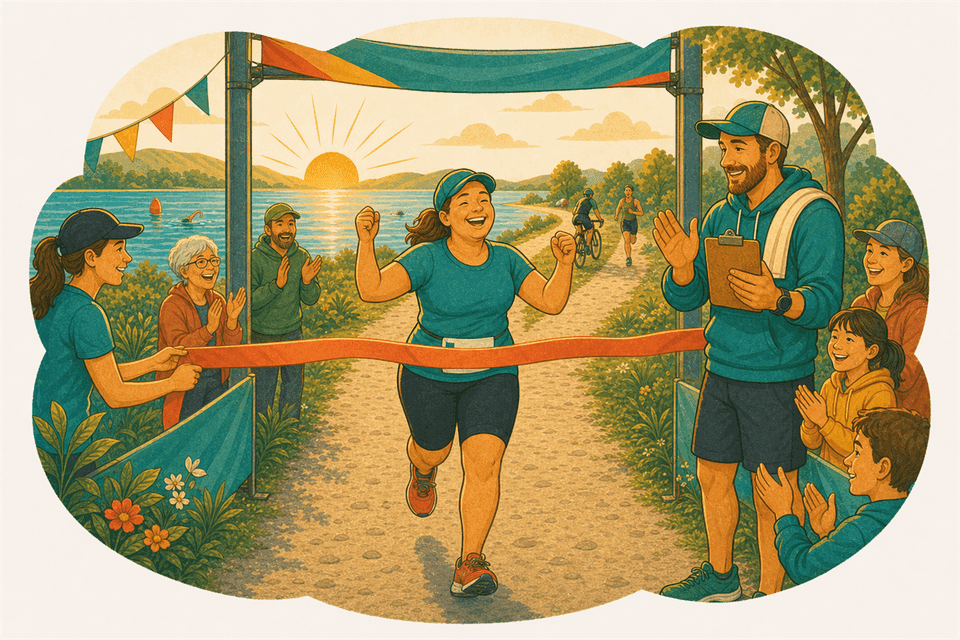
You can admit it here. Part of you is not afraid of the swim, the bike, or the run. Part of you is afraid of being the last one. The one everybody is waiting on. The one walking in while they fold up the finish line.
This fear is so common that it is practically a rite of passage. Naming it is the first step to taking its power away. So let me be direct: you almost certainly will not be last, and even if you were, it would not mean what your brain is telling you it means.
Why "last" is unlikely
At a beginner-friendly sprint triathlon, the field is not a wall of lean, fast athletes. It is a wonderful mess of every age, every body type, and every ability. First-timers. Parents. People in their sixties and seventies. People doing it on a dare. People who could not swim a length a year ago.
Someone in that field is always slower than they expected. Someone took a long rest at the buoy. Someone got a flat. Someone is walking the whole run by choice. The odds that the single slowest person out of the entire field is you, specifically, are low.
And here is the part that matters more: the people at the back are not being judged. They are being cheered. Ask anyone who has volunteered at a race. The loudest cheers of the whole day are saved for the final finishers, because everyone knows those are the people for whom it took the most courage.
Last place and not finishing are not the same thing
The fear of being last often hides a different fear: not finishing at all. Those are separate, and both are manageable.
Finishing is mostly a training question. If you do the gentle, consistent work in the weeks before, your body will be ready to cover the distance. We build you up so the finish line is the expected result, not a gamble. The honest timeline for that build is in how long it really takes to get from the couch to a triathlon.
Being last is mostly a story your brain tells. And it is usually wrong.
What about cutoff times?
This is the practical version of the fear, and it deserves a real answer.
Some races have cutoff times, a clock by which you need to reach certain points or finish. Most beginner-friendly sprint races have generous cutoffs or none at all that a trained beginner would bump into. Longer races (70.3, Ironman) have stricter ones, which is one more reason your first race should be a sprint.
So the practical move is simple: read your specific race athlete guide before you sign up. Look for the swim cutoff and the overall cutoff. If a race has tight cutoffs that worry you, pick a more beginner-friendly one. There are plenty. You get to choose a race that is set up for you to succeed.
What actually happens at the back of the race
Picture the thing you are dreading, then replace it with what is real:
- The volunteers are still there, and they are the kindest people on the course.
- Other finishers who are already done often stay to cheer the last ones in. It is a tradition.
- The announcer frequently makes the final finishers feel like heroes, because they are.
- Nobody remembers who was last. Everybody remembers that they finished.
The back of the pack is not a place of shame. For a lot of people, it is the most emotional part of the whole event.
If it still matters to you, here is how to not be last
There is nothing wrong with wanting a cushion. A few honest levers:
- Do the training. Consistency in the weeks before is what makes race day feel doable. Skipping the build is the main thing that makes a race hard.
- Do not blow up on the swim. Start calm, swim easy, rest if you need to. Panic early costs you the whole race. Calm is fast enough.
- Use the bike well. It is the most forgiving leg. Settle into a steady, sustainable effort and just keep the pedals turning.
- Run-walk the run. You are allowed to walk, and walking smart from the start beats running too hard and falling apart. More on that in can you walk the run in a triathlon.
- Pick a beginner-friendly race. A flat, well-supported, first-timer-friendly sprint stacks the deck in your favor.
A mindset that helps
Try this reframe before race day. Your first triathlon is not a race against the field. It is a race against the version of you who was too scared to start. The moment you cross the start line, you have already beaten that person. The finish line is just where you collect the proof.
Finishing your first triathlon, in any position, puts you in a tiny fraction of people who ever try. Last finisher and first finisher get the same medal and the same title: triathlete.
FAQ
Do triathlons have time limits?
Some do, some do not. Beginner-friendly sprints usually have generous limits or none that a trained beginner would hit. Always check your race athlete guide, and if the cutoffs worry you, choose a different race.
What if I am last out of the water?
Then you start the bike, where you are strong and supported, and you reel people in. The swim is the shortest leg. Being last out of the water decides nothing about your day.
Will they pack up the finish line before I get there?
At a reasonable beginner race within the cutoff, no. The finish stays open for finishers. This is exactly why checking the cutoff in advance matters, so you can race with total confidence that the clock is on your side.
Is it okay to walk if it means I finish?
Completely okay. Finishing by walking is finishing. There is no asterisk on your medal.
The bottom line
You are spending energy being afraid of a thing that probably will not happen, and that would not matter much if it did. Let it go. Train consistently, pick a kind race, start calm, and let yourself become a finisher.
Coach Finn builds you a free plan from exactly where you are and gets you to that start line ready. As always, check with a healthcare professional before starting a new exercise program if you have any medical condition or symptom that concerns you.