6 min read · with Coach Finn
How to Build a Weekly Schedule Around One Free Weekend Day
Part of How Long Does It Really Take to Go From the Couch to a Full Ironman?
Here is the truth most busy beginners never hear: you do not need a wide open calendar to train for a triathlon. If you have one good chunk of time per week, usually a weekend day, you have enough to build real fitness. Everything else can fit into short, easy weekday sessions squeezed around your actual life. I want you to relax into that idea before we go any further, because it is the foundation of everything that follows.
I am Coach Finn, and I have helped a lot of people get to a Sprint start line on exactly this kind of schedule. So let us build yours.
The premise: one long day plus short weekdays is plenty
A Sprint triathlon is short. We are talking a quick swim, a modest bike, and a run you can absolutely finish. Training for it does not require hours every day. It requires consistency and one slightly longer effort each week to teach your body what sustained movement feels like.
That is the whole strategy. One longer session on your free day builds endurance. A handful of short weekday sessions (20 to 40 minutes each) keep all three sports fresh in your body. Most of those sessions stay easy. You are not trying to crush yourself. You are trying to show up often enough that fitness has no choice but to arrive.
If you want a deeper look at the numbers behind weekly frequency, I wrote a whole piece on how many days a week to train for a triathlon. For now, trust me: three to five touches a week, with one of them longer, gets the job done.
How to use your one free day
Your free day is your anchor, so we give it the work that needs the most room: your longest session.
For most beginners, that longest session is the bike, or a brick. A brick is simply a bike ride followed right away by a short run, and it is the single best way to rehearse the strange, heavy-legged feeling of running off the bike. Doing one most weeks means race day holds no surprises.
On your free day, aim for something in the 60 to 90 minute range as you get fitter. Keep the effort mostly easy and conversational. The goal is time on your feet and time in the saddle, not speed. This is where your endurance quietly gets built, one comfortable weekend at a time.
If your free day is a swim-pool day instead, that is fine too. The principle holds: make this your longest, calmest session of the week.
How to fill your weekdays
Weekdays are for short and simple. Think 20 to 40 minutes, and keep most of them easy.
Here is how I like to spread them out:
- A short swim to work on feeling smooth in the water.
- An easy run, kept gentle enough that you could hold a conversation.
- An easy bike, or better yet, a bike commute if you have one. Commuting counts. It absolutely counts.
The magic is that none of these need to be heroic. A 25 minute jog before dinner. A 30 minute swim on your lunch break. A ride to work that doubles as training. If you can only manage short sessions, you are still fully in the game. I broke this idea down further in training for a triathlon in just 30 minutes a day, because short really is enough.
A sample week built around Saturday
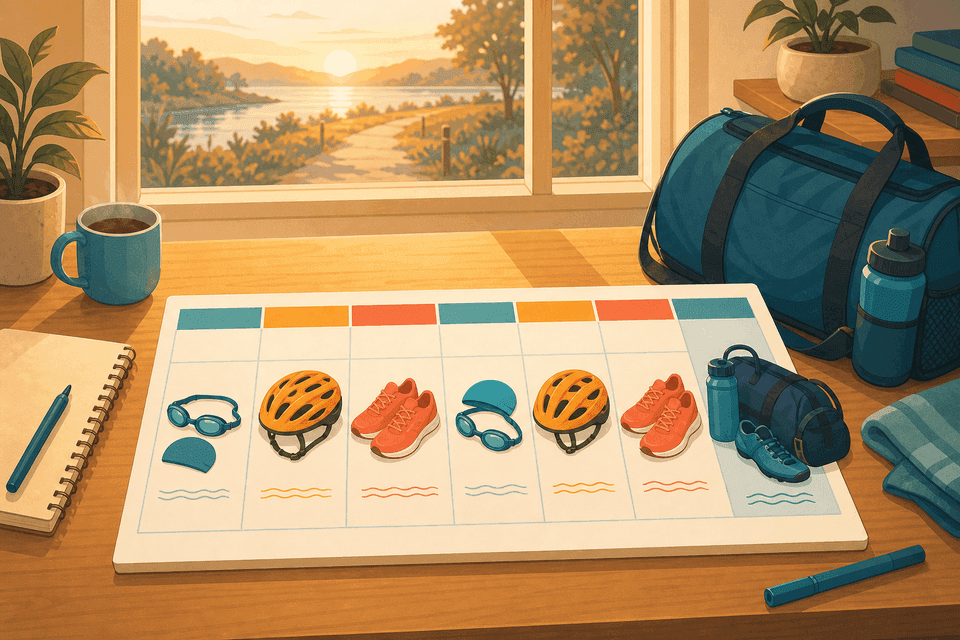
Let us make this concrete. Say Saturday is your free day. Here is one clean way to lay out the week:
| Day | Session | Time |
|---|---|---|
| Monday | Rest or gentle walk | 0 to 20 min |
| Tuesday | Easy run | 25 to 35 min |
| Wednesday | Swim | 30 min |
| Thursday | Easy bike or bike commute | 30 to 40 min |
| Friday | Rest | 0 min |
| Saturday | Long bike or brick (your anchor) | 60 to 90 min |
| Sunday | Optional short swim or rest | 0 to 30 min |
Notice that every sport gets touched: a run, a swim, a bike, and a longer bike or brick. Notice too that there are real rest days built in. Monday and Friday let your body absorb the work, which is when fitness actually sticks.
Rotate the sports, keep your rest
The reason we spread swim, bike, and run across the week is simple: each one asks different things of your body, and touching all three keeps you balanced and injury-resistant. You do not need to hit every sport every week perfectly. You just want each to show up regularly so none of them feels foreign on race day.
And please, keep your rest days. Rest is not laziness, it is part of the plan. Beginners improve during recovery, not during the workout itself. Two easier or off days a week is a healthy rhythm, not a confession.
Stay flexible: swap days as life demands
Now the most important part. This plan is a starting shape, not a contract.
Kid gets sick on Wednesday? Move the swim to Thursday, or skip it. Big work week swallows your weekday sessions? Protect the one long weekend day and let the rest go. The schedule bends around your life, never the other way around. If you want help threading these short sessions through a packed work calendar, I dug into that in fitting triathlon training around a full-time job.
The week above is a template you slide around as needed. Some weeks you will nail all five sessions. Some weeks you will get three. Both kinds of weeks are training. Both move you forward.
Consistency beats perfection, every time
I will leave you with the one belief I want you to carry to the start line: a good plan you can actually follow beats a perfect plan you cannot. The athlete who trains three honest days a week for two months arrives far readier than the one who plans seven and quits by week two.
Build your week around your real life, anchor it with that one good weekend day, and let consistency do the slow, certain work. You have got more time than you think, and you are more capable than you feel right now. When you are ready for plans, encouragement, and a community of beginners doing exactly this, come find us at couchtotri.com. We will be cheering you on, one easy week at a time.