5 min read · with Coach Finn
What Gear Do I Climb a Hill In? A Beginner's Cheat Sheet
Part of Cycling From Zero, When You Have Not Ridden Since Childhood
If you have ever stared down at the little levers on your handlebars and thought, "I have absolutely no idea what any of this does," I want you to know something right away: you are completely normal. Gears confuse almost every beginner. The good news is that they click into place faster than you think, and once they do, hills stop feeling like a wall and start feeling like a puzzle you already know how to solve.
Let's demystify the whole thing together.
Gears in the Simplest Possible Terms
Here is the entire concept in one breath. Your bike has easy gears and hard gears.
Easy gears make pedaling feel light and spinny. Your legs turn quickly without much push needed. These are your friends for climbing hills and for keeping things gentle.
Hard gears make pedaling feel heavy. Each push moves you farther, which is great for going fast on flat ground or rolling down a hill. But they take real muscle.
That is genuinely it. Easy for up, hard for fast. Everything else is just detail.
The Golden Rule for Hills
If you remember nothing else from this post, remember this one thing.
Shift to an easier gear BEFORE the hill gets steep, not in the middle of struggling.
Most beginners wait too long. They hit the bottom of a hill, the pedaling gets hard, they slow down, and only then do they try to shift while pushing with all their might. At that point the gears are under so much pressure that they clunk, skip, or refuse to move at all.
So do it early. As you approach a hill, while the road is still flat and your pedaling is still smooth, drop into an easier gear. Think of it like reading a corner before you reach it. A little planning makes the whole thing feel calm instead of frantic.
Front Shifter vs Rear Shifter, in Plain Words
You have two shifters, usually one on each side of the handlebars. They do different jobs.
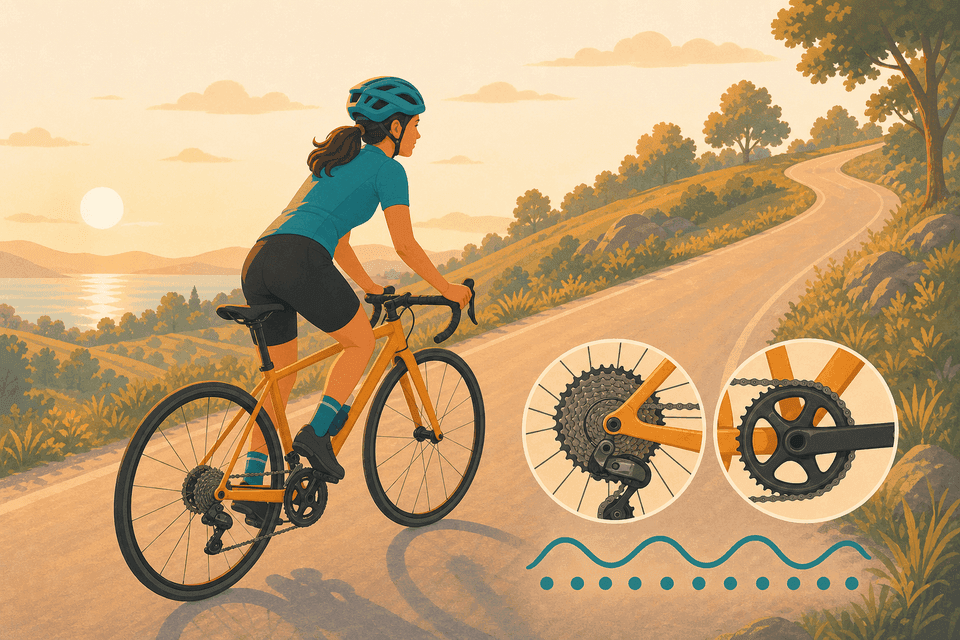
The front shifter makes the big jumps. Think of it as your "huge change" lever. It moves you between major ranges, like flipping from "this is hard" to "this is much easier" in one move.
The rear shifter is for fine tuning. These are your small, polite adjustments. A click here, a click there, until the pedaling feels just right.
A simple way to ride: use the rear shifter for most of your small tweaks on gentle slopes, and reach for the front shifter when the road changes dramatically, like the start of a real climb.
Aim for a Comfortable Spin
Here is a target that will serve you for your entire riding life: aim for a comfortable spin of roughly 70 to 90 pedal turns a minute. One pedal turn is one full circle with either foot.
You do not need to count obsessively. You just want your legs turning at a brisk, easy rhythm rather than slowly stomping on heavy pedals. If you find yourself grinding away, mashing each stroke like you are pushing a boulder, that is your signal to shift to an easier gear and let your legs spin faster.
Why does this matter so much for us? Because grinding a heavy gear is hard on your knees and it drains your legs. In triathlon, you have to run after you ride. Save those legs. A light, quick spin gets you up the hill and leaves something in the tank for the next part.
Do Not Be Afraid of Your Easiest Gear
I hear this one a lot: "Isn't using the easiest gear kind of cheating?"
Not even a little. Your easiest gear exists for exactly this reason. It is a tool, and climbing a hill is the job it was built for. Strong, experienced riders use their easiest gear on steep climbs all the time. Reaching for it is smart riding, not weakness.
And if a hill ever gets the better of you anyway, please know that walking the hills is allowed. There is no shame in stepping off. You will still finish, and you will still be a triathlete.
Your Hill-Climbing Cheat Sheet
Here is everything in a quick list you can glance at before a ride:
- Easy gears: light pedaling, for climbing and spinning.
- Hard gears: heavy pedaling, for flats and downhills.
- Shift to easier BEFORE the hill, not during the struggle.
- Front shifter: big jumps. Rear shifter: fine tuning.
- Aim for 70 to 90 pedal turns a minute.
- Grinding hurts your knees and tires your legs for the run.
- Spinning fast and light is the goal, not pushing hard.
- Your easiest gear is there to be used. Use it.
Practice on Flat Ground First
You do not have to figure all this out mid-climb with traffic behind you. The kindest thing you can do for yourself is practice shifting on flat, quiet ground first.
Find an empty parking lot or a calm street. Pedal along and click through every gear, one at a time. Feel how the front shifter makes a big change and the rear shifter makes a small one. Notice which way makes pedaling easier and which way makes it harder. After ten minutes of this, your hands will start to learn it without your brain having to think. If you are still getting comfortable back on a bike after time away, this kind of low-pressure practice is perfect for rebuilding that easy confidence.
The same calm, prepared mindset helps with other surprises too, like riding in the wind without panicking when a gust shows up out of nowhere.
You Have Got This
Gears feel like a foreign language for about a week, and then one day you shift without even thinking about it. That moment will sneak up on you, I promise. Be patient with yourself while it clicks, because it absolutely will.
So go find a flat spot, play with those levers, and remember the golden rule for your first hill. You are building real skills here, one easy spin at a time. Whenever you want a friendly nudge or your next simple step, we will be right here cheering you on at couchtotri.com. Now get out there and enjoy the ride.