5 min read · with Coach Finn
Can I Do a Triathlon on a Hybrid Bike?
Part of Cycling From Zero, When You Have Not Ridden Since Childhood
Let me give you the short answer first, because I do not want you to worry about it for one more second: yes, you can absolutely do a triathlon on a hybrid bike. People do it at every race, all over the world, every single weekend. Your bike is not the barrier. Showing up is the win, and the bike you already own is the right bike to do it on.
I hear this question all the time from new athletes, and underneath it is usually a quiet fear that they are not "allowed" to be there without fancy gear. You are allowed. Let me walk you through exactly why a hybrid works just fine, what the honest trade-offs are, and a few small things you can do to get ready.
Yes, Almost Every Race Allows Your Bike
Here is the rule at nearly every beginner-friendly triathlon: if your bike is safe and working, you can ride it. That is the whole requirement for most Sprint and Olympic distance races. They want two working brakes, handlebars and a seat that are tight, and tires that hold air. That is it.
Walk through any transition area at a local race and you will see road bikes, sure, but you will also see mountain bikes, hybrids, commuter bikes with baskets still bolted on, and the occasional cruiser. First-timers ride all of these and they all cross the finish line. Nobody at the race is checking whether your bike is "good enough." They are too busy cheering for you.
So What Exactly Is a Hybrid Bike?
A hybrid is exactly what it sounds like: a comfortable mix of a road bike and a mountain bike. It takes the lighter frame and smoother rolling feel of a road bike and blends it with the upright, stable comfort of a mountain bike.
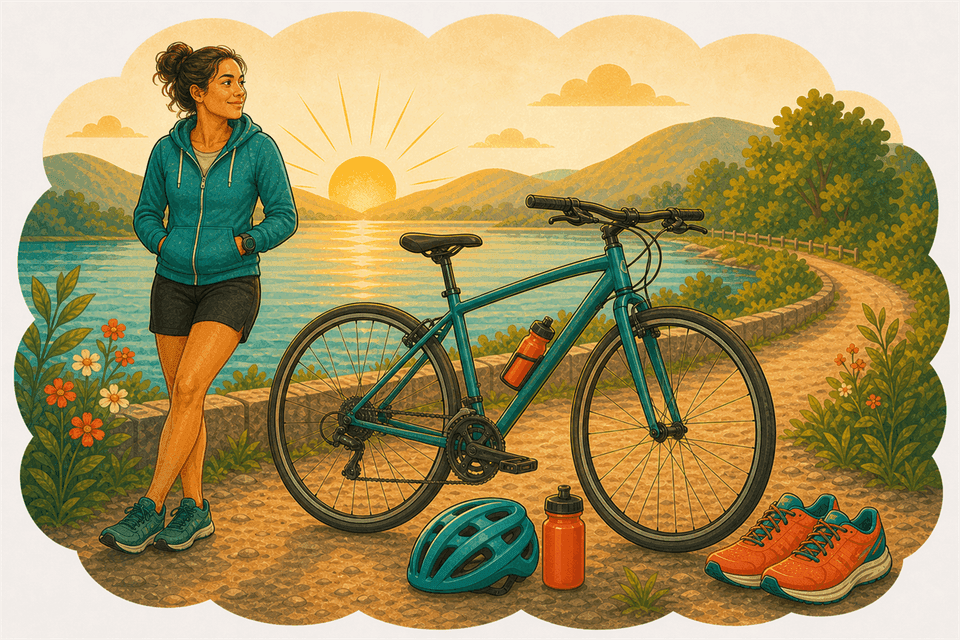
You will usually recognize a hybrid by a few things: flat handlebars (instead of the curled "drop" bars on a road bike), an upright seating position that is easy on your back and neck, and wider tires with a bit more grip. It is built for comfort and everyday riding, which is honestly a lovely place to start. If you want to understand how these bikes compare to the racing machines you see online, I wrote a whole guide on the difference between a road bike and a tri bike that breaks it down without the jargon.
The Honest Trade-Offs (and Why They Do Not Matter Yet)
I am not going to pretend a hybrid is identical to a race bike, because you deserve the truth. A hybrid is a little heavier, and that upright position means you catch a bit more wind. Wider tires roll a touch slower too. Add it all up and yes, you will likely be a little slower on the bike leg than someone next to you on a slick road bike.
And here is the thing: that is completely, totally okay. Your first triathlon is not about your finishing time. It is about finishing, learning how the day flows, and discovering that you can do hard things. A few minutes on the bike split changes nothing about that. Plenty of people on expensive bikes will finish behind you because they trained less or panicked in the swim. The bike is a small piece of a much bigger, more joyful puzzle.
Small Things That Make a Big Difference
You do not need to spend money to make your hybrid race-ready, but a few simple tweaks help it roll easier and keep you safe.
- Pump your tires to the right pressure. Look at the number printed on the side of the tire and pump up to it. Soft tires are slow and harder to handle, and this fix is free.
- Consider smoother tires. If your hybrid came with big knobby off-road tires, swapping them for smoother "slick" or lightly treaded tires is one of the cheapest upgrades that genuinely helps on pavement. It is optional, not required.
- Make sure it is mechanically safe. Squeeze both brakes to check they grab firmly, spin the wheels to make sure nothing rubs, and shift through the gears. If anything feels off, a quick tune-up at a local bike shop is money well spent.
That is the short list. You truly do not need aero wheels or a carbon frame. For the full picture of what matters and what does not, take a look at the gear you actually need for your first triathlon.
Finish on the Bike You Have
I want to gently push back on a trap I see a lot: waiting to sign up until you can afford a "real" tri bike. Please do not do that. The months you spend saving and second-guessing are months you could spend training, growing stronger, and standing at a start line.
Finishing a triathlon on the bike sitting in your garage right now beats waiting indefinitely for a bike you might buy "someday." A good race day costs far less than a road bike, and you can build the rest of your setup for very little. If budget is on your mind, I put together a guide on how to build a tri kit for under $300 so you can see just how doable this is.
And if, after that first finish line, you fall head over heels for this sport? Then you can think about upgrading. Buy the faster bike when you know you love triathlon, not as a ticket to get in the door. The door is already open, and your hybrid rolls right through it.
You Are Ready, and So Is Your Bike
Here is what I want you to take away: the athlete matters far more than the equipment. Your hybrid is safe, capable, and completely welcome at the start line. Pump up those tires, give it a once-over, and go sign up for that race. You will be amazed at what you and your trusty bike can do together.
Whenever you are ready to take the next step, the whole community at couchtotri.com is here to cheer you on, every pedal stroke of the way. You have got this.