5 min read · with Coach Finn
How to Build a Tri Kit for Under $300
Part of The Gear You Actually Need (and All the Stuff You Can Ignore)
Let me guess. You watched someone finish a triathlon, felt that little spark of "maybe I could do that," and then you Googled the gear. Suddenly you are staring at a $3,000 bike, a $500 wetsuit, and a watch that costs more than your car payment. Your spark fizzled, and a quiet voice said, "This is not for people like me."
I want to gently shut that voice up right now. Triathlon has a gatekeeping problem, but the gate is fake. You can get to your first Sprint start line for under $300, and a good chunk of that you might already own. Let me walk you through exactly how.
The $3,000 Bike Is a Myth
Here is the truth that nobody selling carbon fiber wants you to hear: the bike does not make the triathlete. For your first Sprint, which is a short, beginner-friendly distance, you do not need a fancy tri bike. You need a bike that rolls.
A hybrid you have in the garage works. A mountain bike works. A clunky old road bike your neighbor is giving away works. Plenty of people finish their first race on a bike they borrowed the week before. The folks on the $5,000 machines are not faster because of the bike. They are faster because they trained, and you will train too.
So please, do not let the bike stop you. Borrow one. Buy a used one for $100 to $200 on a local marketplace. Or dust off whatever is already hanging in your shed.
What You Actually Need for a First Sprint
Let me strip this down to the real list. A Sprint triathlon is a swim, a bike, and a run, so you need just enough to get through each part safely and comfortably. That is it.
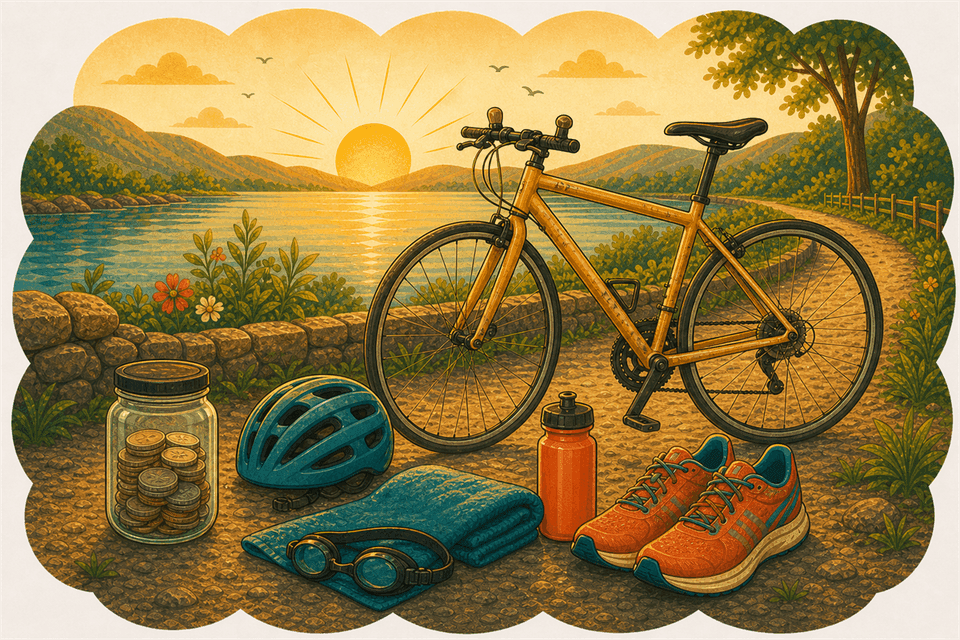
Here is the honest breakdown of what shows up in transition for a first-timer:
- Goggles: A basic pair, around $15 to $25. Get ones that do not leak and call it done.
- Something to wear: A swimsuit you own, or a pair of tri shorts ($30 to $50) that you can swim, bike, and run in without changing.
- A bike: Borrowed (free) or used ($100 to $200).
- A helmet: Non-negotiable, $40 to $60, and we will talk about why in a second.
- Running shoes: Likely already in your closet. $0 if so.
- A race belt: A simple elastic strap to clip your race number on, about $8 to $12.
That is a whole triathlon kit. No wetsuit required for most pool-based or warm-water Sprints, though if your race is in cold open water you will want to read up on whether to rent or buy a wetsuit before spending a dime. Renting almost always wins for your first race.
If you want the deeper version of this, I wrote a full guide on the gear you actually need for your first triathlon that goes piece by piece.
Where to Save and Where to Never Skimp
Most of triathlon is a place to save money. Here is my rule of thumb.
Save freely on: the bike (borrow or buy used), your swimwear (use what you own), your race belt (the cheapest one is fine), and your watch (your phone or a plain stopwatch is plenty for race one). Use what you have. Borrow what you can. Buy used without a shred of guilt.
Do not skimp on two things:
First, your helmet. A used bike is great. A used helmet is not. Helmets are built to absorb one big crash, and you cannot see the damage from a previous one. Buy your helmet new, or only accept one you know for certain has never been crashed. It needs to fit snugly and sit level on your head. This is the single non-negotiable safety item in the whole sport, and a good one only costs $40 to $60. Worth every penny.
Second, shoes that fit your feet. You do not need expensive shoes, but you do need ones that actually fit and do not tear up your feet over a few miles. If the running shoes in your closet fit well, you are set. If they are worn flat or pinch, that is the one shoe-shaped thing worth fixing. A small upgrade that pays off big: why elastic laces are a cheap win for slipping shoes on fast in transition.
A Sample Sub-$300 Starter List
Let me put it all together so you can see it adds up to less than you feared:
- Used or borrowed bike: $0 to $200
- Helmet (new, properly fitted): $40 to $60
- Goggles: $15 to $25
- Tri shorts (or a swimsuit you own): $0 to $50
- Running shoes (likely owned): $0
- Race belt: $8 to $12
- Elastic laces: $8 to $12
Add that up at the higher end and you land somewhere around $250 to $300. At the lower end, if you borrow the bike and use shoes and swimwear you already have, you might spend under $100 to get to your first start line. Either way, you are well inside budget.
The Only Costs You Truly Cannot Avoid
Here is the most freeing part. When you cut away everything optional, the only things you genuinely must pay for new are the race entry fee (usually $60 to $100 for a local Sprint) and a helmet. Everything else can be borrowed, bought used, or pulled from a closet.
That is the real cost of becoming a triathlete: a race entry and a helmet. The rest is just stuff people sell you, and you can add it slowly over years if the sport sticks. You do not need to look the part. You need to show up.
So let that nervous, budget-conscious voice rest. Money is not the barrier here, and it never had to be. You are far closer to that start line than the price tags led you to believe.
I would love to cheer you on, so come on over to couchtotri.com when you are ready to take the next step. We will get you from the couch to that finish line together, one affordable step at a time. You have got this, and I am genuinely glad you are here.