5 min read · with Coach Finn
My Legs Sink When I Swim: The Fix Nobody Told You
Part of The Swim, and the Fear
You push off the wall, you start to swim, and within a few strokes your legs feel like they are dragging an anchor. Your hips drop, your feet sink, and suddenly you are swimming uphill. If that is you, I want you to take a breath and relax, because I have good news.
This is one of the most common things I see, and it is almost never about your legs being weak or about you being "too heavy" in the water. It is about body position and breathing. That is it. And both of those are skills you can learn, starting today.
First, the thing nobody tells you
Sinking legs are a technique puzzle, not a fitness test. Brand new swimmers, strong runners, lifelong cyclists: I have watched all of them sink at the back end and then float beautifully a few weeks later once they changed a couple of small habits.
So please let go of any idea that your body is somehow built wrong for swimming. It is not. Water is happy to hold you up. We just have to stop accidentally fighting it.
Why your legs actually sink
Here are the real culprits. You will probably recognize a few.
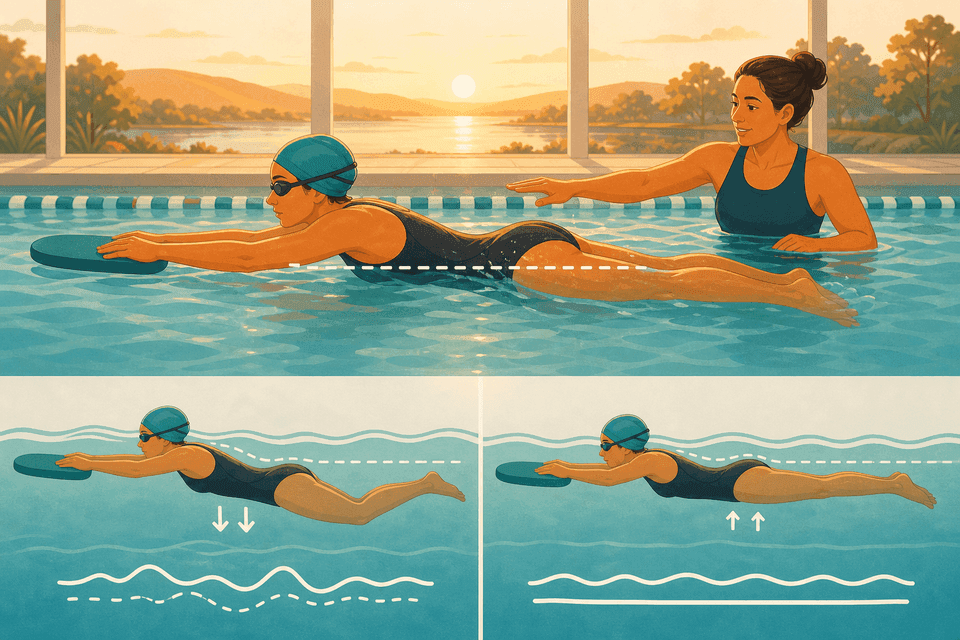
You lift your head to breathe. This is the big one. When your head goes up, your hips go down. Think of your body like a seesaw: raise one end and the other end drops. Lifting your face to grab air shoves your legs straight toward the bottom.
You hold your breath instead of exhaling. If you take in air and then hold it until the next breath, you end up rushing and lifting your head in a panic. Holding your breath also makes you tense, and tense bodies sink. This habit is a big reason people feel out of air so fast, which I dig into in why you gasp after 25 meters.
You look forward instead of down. Staring at the far wall lifts your chin, and your chin pulls your hips down with it.
You are tense. A stiff, clenched body sits lower than a loose, relaxed one. Fear makes us rigid, and rigid does not float.
You kick from the knee. Big bicycle kicks from bent knees create drag and push water down and back instead of helping you stay level.
The fixes, one calm step at a time
You do not need to fix all of these at once. Pick one, give it a few swims, then add another.
Press your chest gently. This is the magic move. Lean lightly on your chest, like you are pressing it a little into the water. When the front of you goes down a touch, the back of you (your hips and legs) comes up. You are using that seesaw on purpose now.
Look straight down. Point your eyes at the bottom of the pool, not forward. Keep the back of your head and your spine in one long line. This single change lifts most people's hips right away.
Exhale steadily underwater. As soon as your face is in the water, let a slow, steady stream of bubbles out through your nose or mouth. When you turn to breathe, your lungs are already empty and ready for fresh air. This keeps you calm, low, and balanced. For the full rhythm, read how to breathe while swimming freestyle.
Relax your whole body. Soft hands, soft jaw, soft shoulders. A loose body floats higher than a tight one, every single time.
Kick from your hips. Keep your legs long with a gentle bend, and let the kick start at the hip, not the knee. Small, floppy feet, easy motion.
Try a slightly faster easy kick. Here is a little secret: a light, quick flutter kick adds buoyancy at the back and helps keep you level. Not a hard kick, just a steady patter that keeps your legs near the surface.
Simple drills to feel it for yourself
Drills let you practice one piece without juggling everything at once.
Kick on your back. Float on your back, arms at your sides, and do a gentle flutter kick across the pool. Feel how relaxed and level you can be. This teaches your body that the water will hold you.
Push and glide. Push off the wall, face down, arms stretched in front, looking straight at the bottom. Just glide and notice your body line. Press your chest a little and watch your legs rise. No kicking, no stroking, only feeling that balance.
Balance with a pull buoy. A pull buoy is a small foam float you tuck between your thighs. Pop it in, push off, and swim easy. It holds your legs up so you can feel what a level, floating body actually feels like. Use it as a learning aid, a way to teach your body the target position, not a crutch forever.
Do these for five or ten minutes at the start of a swim. They add up faster than you would think.
A little extra help on race day
If you are training for a Sprint, an Olympic, a 70.3, or one day even an Ironman, here is some reassurance. On race day, the water itself often helps you.
A wetsuit adds a lot of buoyancy, especially around your hips and legs, so many swimmers who sink in the pool float much higher with one on. And if your event is in the ocean, salt water is more buoyant than the pool you are training in. Both of these lift you up exactly where you have been struggling. So the pool is the hard mode, and you are practicing in the harder version. That is a good thing.
You can do this
Sinking legs are not a sign that swimming is not for you. They are just a sign that your body has not learned its new floating position yet, and that is completely fixable. Press your chest, look down, breathe out slow, and stay loose. Give it time and your legs will come up.
If you are early in all of this and the whole thing still feels big, that is okay too. Start gently with starting from I cant swim but want to do a triathlon, and take it one calm lap at a time.
You belong in the water, and you belong in this sport. We will get you there together, one swim at a time, and the whole crew at couchtotri.com is cheering you on the whole way.