5 min read · with Coach Finn
Do I Need a Bike Computer for My First Triathlon?
Part of The Gear You Actually Need (and All the Stuff You Can Ignore)
Let me give you the honest answer right up front: no, you do not need a bike computer for your first triathlon. Not even a little. You can show up, ride your bike, finish your race, and have a wonderful day without one. So if you came here worried that you are missing a required piece of gear, you can relax. This is optional, and your first race does not depend on it.
Now that the pressure is off, let us talk about what these gadgets actually do, what you can use instead, and whether you might want one down the road. No hype, no shame, just a friendly walkthrough.
What a Bike Computer Actually Does
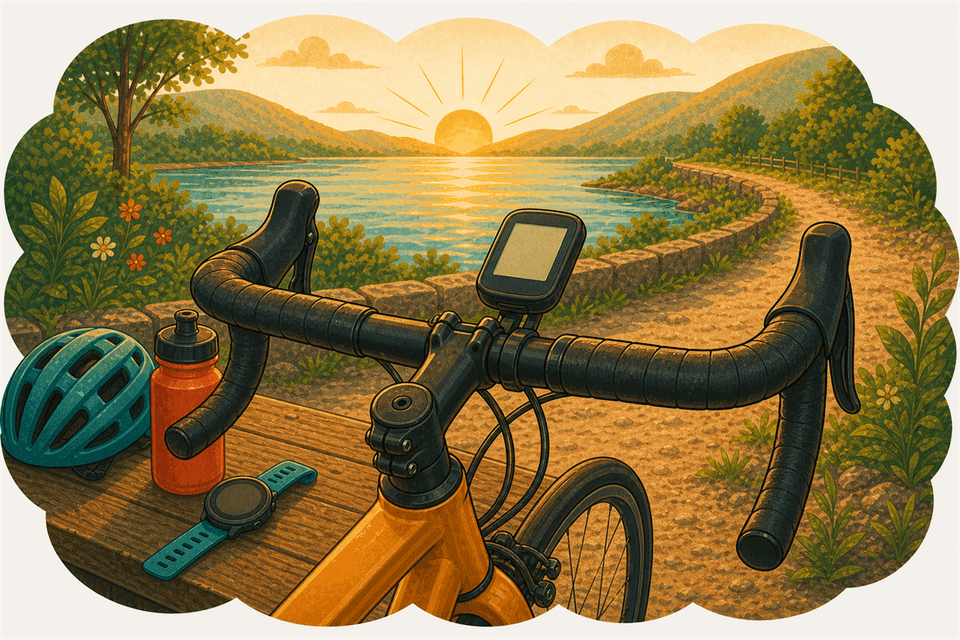
A bike computer is a small screen that mounts on your handlebars and shows you information while you ride. Most of them tell you your current speed, how far you have gone, and how long you have been riding. Fancier ones can also show cadence (how fast your legs are spinning), heart rate, and even maps with turn-by-turn directions.
They figure out distance and speed in one of two ways. Some use GPS, the same satellite signals your phone uses, to track where you are. Others use a little sensor on your wheel that counts each rotation. Both work fine. The point is simply that the device is doing the math so you can glance down and see a number.
That is really all it is: a small computer that keeps track of your ride for you. Helpful? Sometimes. Required? Not at all.
The Free Alternatives You Already Have
Here is the good news. You almost certainly own something right now that does the same basic job.
Your phone is the easiest option. Pop it in a jersey pocket or a small handlebar mount, open a free app like Strava or your phone's built-in fitness tracker, and it will record your distance, speed, and time using GPS. When you finish, you can see your whole ride.
A basic GPS watch works too. If you already wear a running watch, many of them have a cycling mode. Start it at the beginning of your ride and it tracks the same numbers a bike computer would, right there on your wrist.
And then there is the oldest method of all: riding by feel. You head out, you pedal at a pace that feels steady and sustainable, and you simply pay attention to your body and the road. On a known route, you already have a rough sense of how far you have gone. Plenty of happy cyclists ride this way for years and never look at a single number.
The Pros, If You Decide You Want One
I do not want to talk you out of a bike computer if the idea excites you. There are real reasons people enjoy them.
A computer can help with pacing, so you do not sprint out of the gate and run out of gas. It lets you track your progress over weeks and months, which is genuinely motivating when you see yourself getting stronger. It tells you how far you have gone on long training rides, which is reassuring when you are exploring new routes. And for some people, watching the numbers tick up is just plain fun and keeps them coming back to train.
If you love data, you will probably love a bike computer. That is a perfectly good reason to get one.
The Cons Worth Knowing
There are a few downsides, and they matter more for a nervous beginner than for a seasoned rider.
First, cost. A decent computer is money you could spend elsewhere, or simply save. Second, it is one more thing to learn, set up, and remember to charge. On a busy race morning, a dead battery or a setting you cannot find is exactly the kind of small stress you do not need. Third, and this is the big one, the numbers can distract you. When you are new and a little anxious, staring at a screen can pull you out of the moment when your only real job is to relax and ride.
For your first race, simpler is calmer, and calmer is faster than you would think.
On Race Day, the Course Does the Work
Here is the part that makes all of this easy. On race day, you do not need to track distance at all. The course is measured for you, and it is marked along the way with signs, cones, and volunteers pointing you in the right direction. Whether you are doing a Sprint or stepping up to an Olympic distance later, the organizers have already handled the measuring. Your job is to follow the course and pedal. That is it.
So even if you are the type who likes to know exactly how far you have gone, race day removes that worry entirely. The markers tell you where you are.
My Honest Recommendation
Start simple. For your first triathlon, use your phone or a basic watch, or just ride by feel, and put your energy into the things that actually affect your day. Knowing the gear you actually need for your first triathlon matters far more than any screen. So does sorting out what tire pressure a beginner should run, which makes a bigger difference to how your bike feels than any gadget ever will.
If, after a race or two, you find that you genuinely enjoy data, or you move up to longer distances like a 70.3 or someday an Ironman, that is the moment to add a bike computer. The same goes for deciding whether you need a heart rate monitor: add it later, only if you want it. Buy gear because it brings you joy or solves a real problem, not because you feel you are supposed to.
You have everything you need to ride your first triathlon already. Keep it simple, trust your training, and enjoy the ride. We will be cheering you on every pedal stroke of the way here at couchtotri.com, and we cannot wait to hear how your first race goes.