6 min read · with Coach Finn
Pool vs Open Water: Which for Your First Triathlon Swim?
Part of The Swim, and the Fear
If you are standing at the edge of signing up for your first triathlon and the swim is the part that makes your stomach flip, you are in exactly the right place. One of the biggest choices you get to make, and it really is a choice, is whether your first race has a pool swim or an open-water swim. They feel like two different sports. So let me walk you through what each one is actually like, and then I will give you my honest coach recommendation. No pressure, no shame, just the real picture.
What a Pool-Swim Race Actually Feels Like
A pool-swim triathlon is about as gentle an introduction as the sport offers, and I mean that as a high compliment.
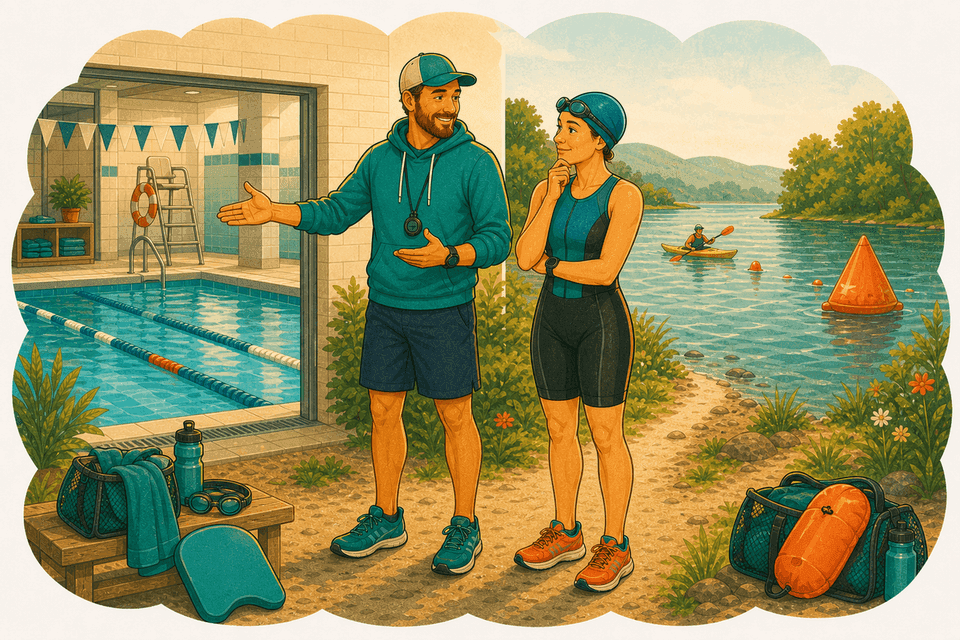
Picture it. The water is clear and calm. You can see the bottom. There is a black line painted on the floor of the pool to follow, so you always know where you are going. There is a wall every 25 meters (or 25 yards), which means you are never more than a few strokes from something solid to grab. If you need a breather, you stop at the wall, hang on, and catch your breath for as long as you like. Nobody is going to rush you.
The water is usually a comfortable temperature, often around 27 to 28 degrees Celsius, so no shock of cold. Lane lines keep swimmers separated and tidy. A lifeguard is sitting right there, watching, the whole time. In many pool races you can even stand up in the shallow end and walk a bit if you need to reset.
One more kind detail. Pool races are often seeded by your predicted swim time, so you write down a realistic guess and you get placed with people swimming at a similar pace. That means you are far less likely to have a faster swimmer climbing over the top of you. You go when it is your turn, in your own space.
For a first-timer, this is a calm, contained, you-can-do-this kind of swim.
What an Open-Water Race Actually Feels Like
Open water is a lake, a river, or the sea. It is beautiful and it is a genuinely different experience, so I want to be honest about it rather than dress it up.
There are no walls. None. If you get tired, there is no edge to grab and no bottom to stand on once you are out past the shallows, so you rest by rolling onto your back or floating, which is a skill worth practicing before race day. The water is often darker, sometimes you cannot see your own hands, and that can feel disorienting the first time even for confident pool swimmers.
You also have to sight, which means lifting your eyes to spot a buoy and aim for it, because there is no black line to follow. There are other swimmers around you, and at the start it can feel crowded, with the occasional bump or kick. Open water is usually colder, so most open-water races have you wear a wetsuit, which is actually lovely news because it keeps you warm and it makes you more buoyant, so floating is easier.
None of this is meant to scare you off. Plenty of nervous beginners grow to love open water. I just never want it to surprise you. If the idea of dark water and no walls makes your chest tighten, that is a completely normal reaction, and there is a whole separate piece of mine on how to not panic in open water for when you are ready to build that skill.
So Which Should You Choose for Your First Race?
Here is my honest recommendation, the same one I would give a friend.
For your very first triathlon, choose a pool swim if you can find one. The walls, the clear water, the lifeguard a few feet away, the ability to stop and stand, all of it removes so much of the fear so you can focus on simply finishing and enjoying your day. You will cross that line knowing you can do this, and that confidence is worth everything.
If a pool race is not available in your area, the next best thing is a calm, shallow lake on a warm day, ideally one with a gentle, well-supervised entry and a short swim course. Many beginner-friendly events are designed exactly this way, with kayakers and safety boats dotted along the route.
What I would gently steer you away from for a first race is the open ocean. Waves, currents, tides, and chop add layers of challenge that you simply do not need while you are still learning what race morning feels like. The ocean will still be there later, I promise, and you will meet it with much more confidence once you have a finish line or two behind you.
If you want help weighing up the whole event and not just the swim, I walk through it all in how to choose your first triathlon.
Open Water Is a Skill You Add Later, Not a Requirement to Start
I want to say this clearly because so many beginners get it backwards. You do not have to be an open-water swimmer to be a triathlete. Open water is a skill you can add on later, at your own pace, long after your first finish line, if and when you want to.
A lot of the swim fear I see comes from people assuming that "real" triathlon means cold, dark, deep water from day one. It does not. You get to start where it feels safe, build from there, and let the harder stuff come when you are ready for it, never before. If you have not read it yet, my piece on the swim, and the fear sits underneath everything I am telling you here.
And one safety note I will always repeat, gently. When you do start practicing open water, never swim it alone. Go with a buddy, a coached group, or a supervised open-water venue with lifeguards. That is not about doubting you. It is just the rule we all keep, even the fastest among us.
You Get to Choose the Kind Door
Here is the warm truth to carry with you. There is no brave door and no cowardly door into this sport. A pool swim is not the easy way out. It is a smart, kind, completely legitimate way in, and the finish line you earn there counts every bit as much.
So pick the swim that lets you breathe a little easier, sign up, and let yourself be a beginner. That is exactly what you are meant to be right now. If you would like a gentle, step-by-step plan that meets you where you are, you can grab a free one at couchtotri.com, and I will be right there with you from your very first splash.