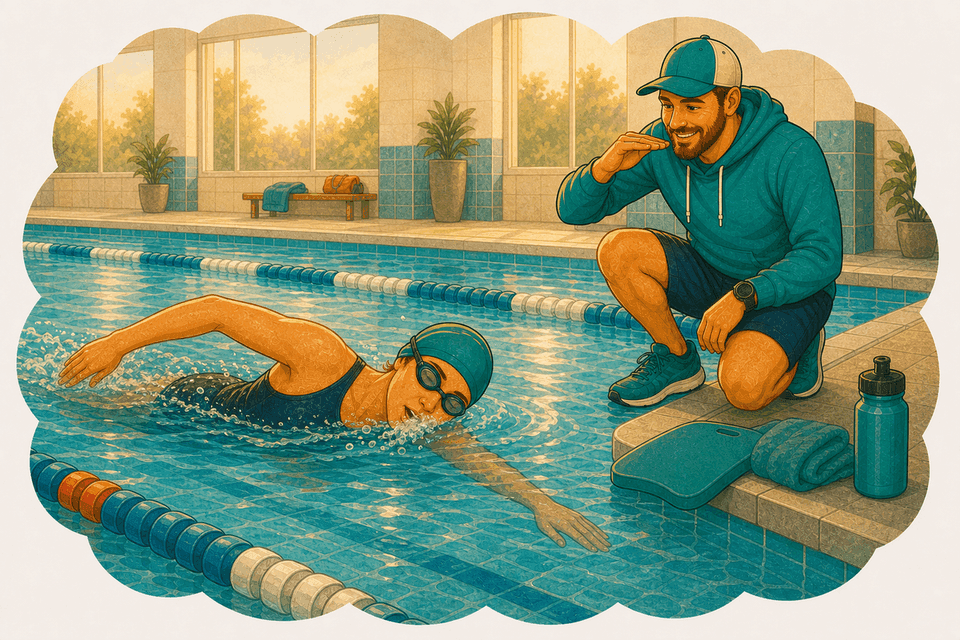
6 min read · with Coach Finn
How Do I Stop Swallowing Pool Water Every Lap?
Part of The Swim, and the Fear
If you finish every length coughing, spluttering, and wondering how on earth you swallowed half the pool again, I want you to know something first. You are not bad at this. Almost every beginner I coach goes through exactly this stage. The good news is that swallowing water is not a sign you cannot swim. It is usually a sign of one small timing habit, and timing habits are very fixable. Let me walk you through why it happens and how to make it stop.
Why You Keep Getting a Mouthful
Swallowing or inhaling water almost never happens because you are doing something deeply wrong. It happens because of a few small things stacking up.
The most common culprit is breathing in too late. You turn for air at the very last second, when your lungs are already empty and a little panicky, so you gulp fast and hard and the gulp pulls in whatever is near your mouth, including water.
The second culprit is lifting your head instead of rotating your body. When you crane your head up and forward to find air, your mouth comes up but the water in front of you piles up right at your lips, so you breathe straight into it.
The third is holding your breath underwater instead of breathing out. If you store all your air and then try to both exhale and inhale in the tiny window when your mouth clears the surface, there is simply not enough time. You end up inhaling before you have finished blowing out, and water comes along for the ride.
And the fourth is plain old panic. Once you have choked once, your body tenses and rushes the next breath, which makes the next mouthful more likely. It becomes a loop. We are going to break that loop.
The One Fix That Changes Everything: Exhale Underwater
If you remember nothing else from this article, remember this. You should only ever breathe IN at the surface. Breathing OUT happens underwater, the whole time your face is down.
Here is why this matters so much. If your lungs are already empty when your mouth reaches the air, your only job is a quick, clean inhale. There is no frantic blow-out-then-suck-in scramble crammed into half a second. That scramble is what pulls in water.
So practice this in water you can stand up in. Hold the wall, take a breath, and put your face in. Now hum or blow a slow, steady stream of bubbles out through your nose and mouth the entire time your face is down. Do not hold it. Do not save it. Just a calm, continuous trickle of bubbles. When you turn to the side for air, your lungs are already empty and ready, so you simply breathe in. Try ten of those at the wall before you ever push off. This single change fixes the swallowing problem for most of the beginners I work with, and we go deeper on the whole breathing pattern in how to breathe in freestyle.
Rotate, Do Not Lift: Finding the Trough
Now for the head. The instinct to lift your face up out of the water is completely natural and completely backwards. Lifting drops your hips, slows you down, and brings your mouth up right into the choppy water you just pushed forward.
Instead, you want to rotate. Think of your body as turning on a skewer that runs from your head to your toes. When you roll onto your side to breathe, your head rolls with your body, and your mouth turns to the side rather than craning up. You are not trying to get high above the water. You are turning to find the little pocket of calm air beside you.
That pocket has a name. As you move forward, your head pushes a small bow wave, and just behind your head the water dips down into a little trough. Your mouth sits naturally in that trough when you rotate. You barely have to clear the surface at all because the water level right there is lower. One cheek stays in the water, you sneak the breath from the trough, and you roll back down. No craning, no reaching, no piling water at your lips.
Slow Down and Time the Breath
Speed is not your friend yet, and that is fine. When beginners rush, every part of the stroke gets compressed, including the breath, and a compressed breath is a choking breath.
So slow everything down. Give yourself a long, lazy stretch out front with your leading arm before you turn for air. Begin the head rotation a touch earlier than feels necessary, so your mouth reaches the air with time to spare rather than at the last desperate moment. Breathe in calmly, then roll your face back down and start your slow bubbles again immediately. Slow stroke, early turn, calm inhale, steady exhale. That rhythm is what keeps the water out. If you find you can only manage a length before everything falls apart and you are gasping, that is its own common hurdle, and I wrote about it in why you gas out after 25 meters.
When You Do Get a Mouthful Anyway
You will still get the odd gulp now and then, and I want to be very clear about this. It is harmless and it is normal. A little pool water has never hurt anybody, and coughing is just your body doing its job.
So here is the plan for when it happens. Stop. Do not try to power through it mid-stroke. If you can touch the bottom, stand up. If you are in deeper water, roll onto your back and float, or hold the wall or lane rope. Get your feet under you, cough it out, take a few easy breaths, and let your heart rate settle. There is no prize for not stopping. Resting is part of the practice, not a failure of it.
Once you feel calm again, reset and push off. The worst thing you can do is panic and rush straight back in while still flustered, because a flustered breath invites the next mouthful. Calm first, then swim.
This is exactly the kind of fear we talk about gently in the swim, and the fear, and it fades faster than you would believe once the breathing clicks.
You are closer than you think. Exhale underwater, rotate instead of lifting, slow it all down, and rest whenever you need to. Do those four things and the spluttering quietly disappears. We will keep working through every little hurdle together, one calm length at a time, here at couchtotri.com.