6 min read · with Coach Finn
The Triathlon Swim Cutoff Time, Explained Without the Panic
Part of The Swim, and the Fear
If the words "swim cutoff" make your stomach drop, I want you to take a breath with me. You are not the first beginner to lie awake imagining a kayak paddling over to pull you out of the water in front of everyone. It is one of the most common fears I hear, and it is almost always bigger in your head than it is in real life. So let us turn the lights on and look at this thing directly, because facts are a lot calmer than imagination.
What a Swim Cutoff Time Actually Is
A cutoff time is simply a maximum amount of time you are given to finish a part of the race, or sometimes the whole race. It exists for two boring, reassuring reasons: safety and logistics.
Safety means the volunteers, lifeguards, and water-safety crews can only stay on duty for so long, and the race wants everyone accounted for while support is still on the water. Logistics means roads have to reopen, timing mats get packed up, and the event has a schedule it agreed to with the town or park.
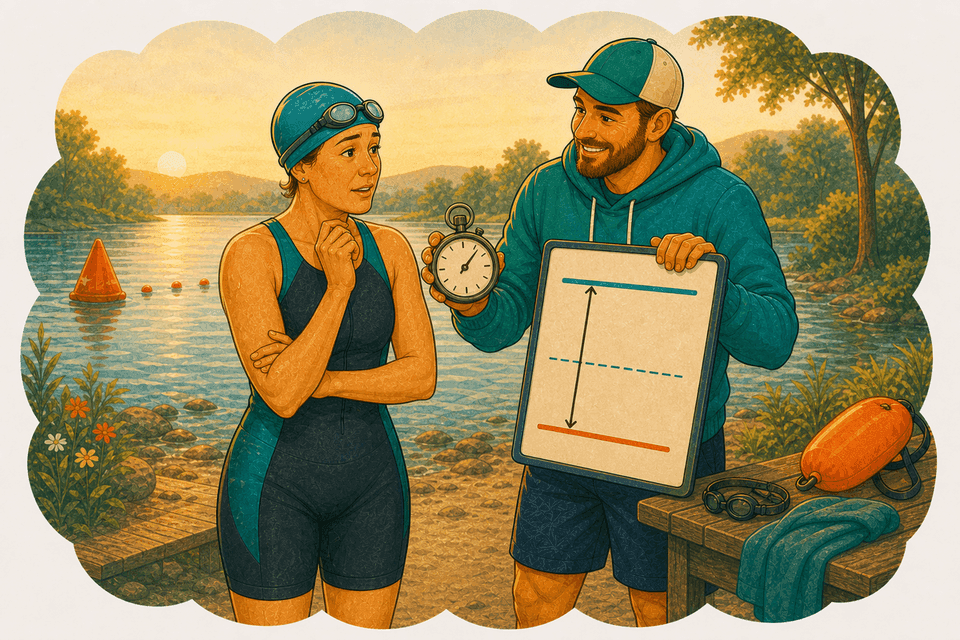
So a cutoff is not a judgment on whether you belong there. It is a fence built far out at the edge of the course to keep everyone safe and on time. Most beginners never get anywhere near that fence. They just do not know where it is, so they assume it is right behind them.
There are usually a few kinds of cutoff: one for the swim alone, sometimes one for getting out of the water and onto the bike, and an overall finish time. The swim one is the famous scary one, so that is the one we will spend the most time on.
Why Sprint-Distance Cutoffs Are So Generous
Here is the part that quietly fixes most of the fear. Sprint-distance triathlons, the kind I steer almost every beginner toward first, tend to have very forgiving swim cutoffs.
A sprint swim is usually around 750 meters, and many beginner-friendly races are shorter. Race organizers know that first-timers, nervous swimmers, and people who learned to swim as adults are a big part of the field. They build the cutoff around that reality, not around fast club swimmers.
Let me give you a rough, real-world sense of the math. Plenty of sprint races give you somewhere in the range of 20 to 35 minutes for the swim, and some give even more. To cover 750 meters in 30 minutes, you only need to average about 4 minutes per 100 meters. That is slow. That is a very gentle, catch-your-breath, look-around-and-sight pace. Many beginners who think they are slow are actually swimming closer to 3 minutes per 100 meters once the nerves settle.
So when you read a cutoff and do the arithmetic, the usual reaction is not panic. It is "oh, that is way more time than I thought." If you would like to talk yourself the rest of the way down from the start-line nerves, I wrote a whole gentle piece on the swim, and the fear that pairs nicely with this one.
You Can Use Any Stroke, and You Can Rest
This is the rule that surprises people most, so let me say it plainly. The clock does not care how you get across.
You can swim freestyle. You can swim breaststroke the entire way. You can switch to backstroke when your chest gets tight and you want to look at the sky for a minute. You can sidestroke, dog-paddle, or do that hybrid survival stroke that has no name. None of it disqualifies you, and none of it makes you a fake triathlete. Finishing the distance is finishing the distance.
You are also allowed to rest. Most open-water swims have kayaks, paddleboards, or buoys spaced along the course, and you are permitted to stop and hold onto one to catch your breath, as long as it does not pull you forward. Floating on your back for thirty seconds to reset your breathing is completely fine and completely normal. Resting like this does not mean you are out of the race. It means you are swimming smart. The only thing that usually is not allowed is using a flotation aid to gain an advantage, but pausing at a kayak to breathe is the system working exactly as designed.
When you build that resting into your pace, the cutoff gets even more comfortable, because the time you lose floating is tiny compared to the buffer you already have.
How to Find Your Cutoff and Make Sure It Is Comfortable
You never have to guess at this, and I do not want you to. Every reputable race publishes its cutoff times, and you can check them before you ever pay a registration fee.
Here is how I want you to do it:
- Go to the race website and look for the page called Athlete Guide, Race Rules, Course Info, or Important Information.
- Find the swim cutoff (and the overall cutoff if one is listed). Write down the number.
- Divide the swim distance by the time to find the pace you would need. For a 750 meter swim with a 30 minute cutoff, that is 4 minutes per 100 meters.
- Compare that to your easy pace in the pool. If your comfortable, talking-to-yourself pace is faster than the required pace, you have margin to spare.
If a race ever has a tight cutoff or does not publish one clearly, that is useful information too. It is a perfectly good reason to pick a different, more beginner-friendly event. Choosing the right first race removes most of this worry before training even starts, which is exactly why I put together a guide on how to choose your first triathlon.
What Actually Happens If Someone Misses It
Let us walk all the way up to the worst case, because the imagined version is scarier than the real one.
First, missing a sprint swim cutoff is genuinely rare for a beginner who trained, picked a sensible race, and can cover the distance with rest. It happens far less than the fear suggests.
Second, if it does happen, it is handled with kindness, not humiliation. There is no whistle, no announcer, no crowd of disappointed faces. Usually a water-safety volunteer quietly comes alongside, checks that you are okay, and either lets you continue outside the official timing or gives you a calm ride back to shore. They do this all the time. They are not there to shame you. They are there to look after you.
Third, even in that rare case, you still swam in open water on race morning, which is something most people on earth never do. That is not a failure. That is a starting point. If the fear of finishing at the back of the pack is also rattling around in your head, I unpacked that one separately in will I finish last in a triathlon, and the short answer is kinder than you expect.
A Calm Word Before You Go
The swim cutoff is a safety fence at the far edge of the course, not a trap waiting right behind you. Pick a beginner-friendly sprint, read the published cutoff, check that your easy pace fits inside it with room to breathe, and let yourself rest whenever you need to. Do that, and the cutoff stops being a fear and becomes a footnote.
When you are ready to train for that swim with a plan built for nervous, first-time bodies, there is a free beginner plan waiting for you at couchtotri.com. Take it one easy lap at a time. You have more room than you think.