6 min read · with Coach Finn
How Do I Start Swimming at 40 (or 50, or 60)?
Part of The Swim, and the Fear
You are reading this because something in you wants to swim. Maybe a triathlon dream, maybe a quiet wish from childhood, maybe just the pull of cool water on a warm day. And right behind that wish sits a worry. Is it too late? Let me answer that first, clearly and warmly. No, it is not too late. Not at 40, not at 50, not at 60, not beyond. People learn to swim at every age, and you can too. Let me walk you through how, one calm step at a time.
It Is Genuinely Not Too Late
Here is something worth holding onto. Adults are wonderful swim learners. Different from kids, yes, but not worse. Children learn by splashing around until something clicks. You get to learn with your full brain, your patience, and your ability to understand what your body is doing and why. That is a real advantage.
Your body is more buoyant than you might fear. Water holds you up. It does not care how old you are, how fit you are, or how long it has been. The same physics that floated you as a child floats you now. Many people who start in their fifties and sixties are swimming comfortably within a season, and they often tell me they wish they had begun sooner instead of waiting on the worry.
One gentle note before the water. If you have a heart or lung condition, another health concern, or you have been inactive for a long stretch, have a quick word with your doctor before you start. It is a small, kind thing to do for yourself, and it lets you step in with confidence rather than question marks.
The Real Hurdle Is in Your Head, Not the Pool
Let me say the quiet part out loud. For a lot of grown-ups, the hardest part of learning to swim is not the swimming. It is the feeling of being a beginner in a space that looks young and fit and sure of itself. You picture lean swimmers slicing through lanes while you stand in the shallow end feeling exposed.
So here is the truth, and I mean it. Nobody is watching you. The fast swimmers are counting their own laps and thinking about their own stroke. The lifeguard is doing their job, glad to see someone new. The other beginners, and there are always other beginners, are too busy with their own bubbles to notice yours. Everyone in that pool was a beginner once, splashing and unsure. You belong there exactly as much as anyone.
If this fear feels heavy, you are in good company, and it is worth naming. I wrote more about it in the swim, and the fear, and a lot of people find comfort there. The feeling is real, but it shrinks fast once you are actually in the water and moving.
A Gentle First-Steps Plan
You do not learn to swim by jumping in the deep end. You learn it in pieces, in water you can stand up in, with nothing to prove. Here is the order I love for beginners. Take each step until it feels easy, then move on. There is no schedule but your own.
Get comfortable in shallow water. Stand in water around waist or chest deep. Walk across the pool. Bounce a little. Let yourself get used to how the water moves around you and holds you. This step matters more than people think, so give it real time.
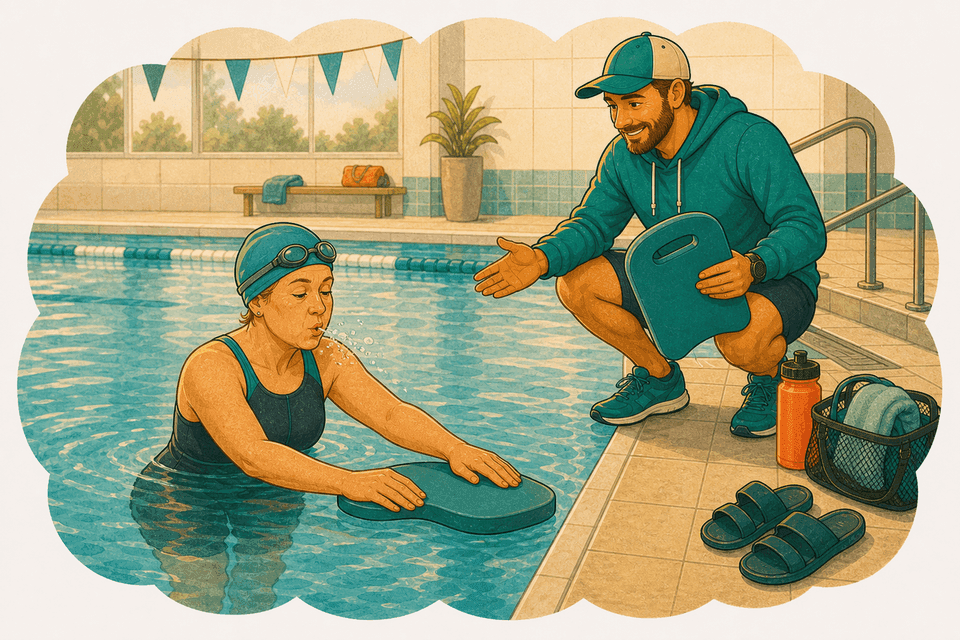
Blow bubbles. Lower your face to the surface and breathe out slowly through your nose and mouth. Watch the bubbles. This teaches your body that exhaling underwater is calm and normal, which quietly removes a huge amount of fear.
Float. Holding the wall or a friend's hands, let your feet lift and practice floating on your front, then your back. Back floating is restful and worth loving. Trust the water to hold you, because it will.
Glide. Push gently off the wall with your face in the water and let yourself slide forward, arms ahead, like a little arrow. Feel how far one push carries you. This is your first taste of actually moving through water.
Add breathing. Once gliding feels friendly, practice turning your head to the side to breathe, or lifting it as you find your rhythm. Slow and unhurried always wins here.
Swim short distances. Now stitch it together. A few strokes, then stand. A width of the pool, then rest. Short and repeatable beats long and exhausting every single time.
That is the whole arc. Nothing in it requires you to be brave all at once.
Make It Easy on Yourself
Learning is so much kinder when you set the stage well. A few things make a real difference.
Go at your own pace and mean it. There is no race to the next step. If blowing bubbles took you three visits to enjoy, that is three good visits. Progress in swimming is not a straight line, and slow progress is still progress.
Think seriously about an adult swim lesson. Many pools run classes built just for grown-up beginners, and a patient instructor will save you months of guessing. If lessons are not your thing, a calm friend who swims well can stand in the shallow end and cheer you on. Either way, having a steady person nearby turns nervous into safe.
Pick quiet pool times. Early mornings, mid-mornings on weekdays, and early afternoons are often peaceful. Call your pool and ask when the lanes are calmest. An empty, quiet pool is a gift to a beginner, all that space and none of the eyes you were worried about.
And listen to your body. Rest when you need to. Stop before you are exhausted, not after. Tired arms and a little water up the nose are normal. Pain, dizziness, or real breathlessness are signs to get out, sit down, and try again another day. Gentle and steady is the path, never grit your teeth and push.
You Have Plenty of Time
Here is a thought I want to leave with you. The fear that you are too late is almost always louder than it is true. Plenty of triathletes learned to swim as adults, started slow and nervous, and now move through the water like it was always theirs. If your bigger dream is a finish line someday, you might enjoy I can't swim but want to do a triathlon, and if the worry of being slowest is on your mind, will I finish last in a triathlon was written gently for you.
For now, the only goal is the next small step. Shallow water. A few bubbles. A quiet float. That is how every swimmer you admire began.
When you are ready for a calm, beginner-friendly way forward, there is a free plan waiting for you at couchtotri.com, built for people starting exactly where you are. Take your time, breathe easy, and I will see you in the water.