5 min read · with Coach Finn
A Race Belt: What It Is and Why You Want One
Part of The Gear You Actually Need (and All the Stuff You Can Ignore)
Let me tell you about one of my favorite small purchases in this whole sport. It costs about as much as a sandwich, it weighs almost nothing, and it quietly solves a problem that trips up a lot of first-timers. I am talking about the race belt. If you have never heard of one, you are in exactly the right place, and by the end of this you will know what it is, why triathletes love it, and how to use it without a moment of fuss.
So What Is a Race Belt, Exactly?
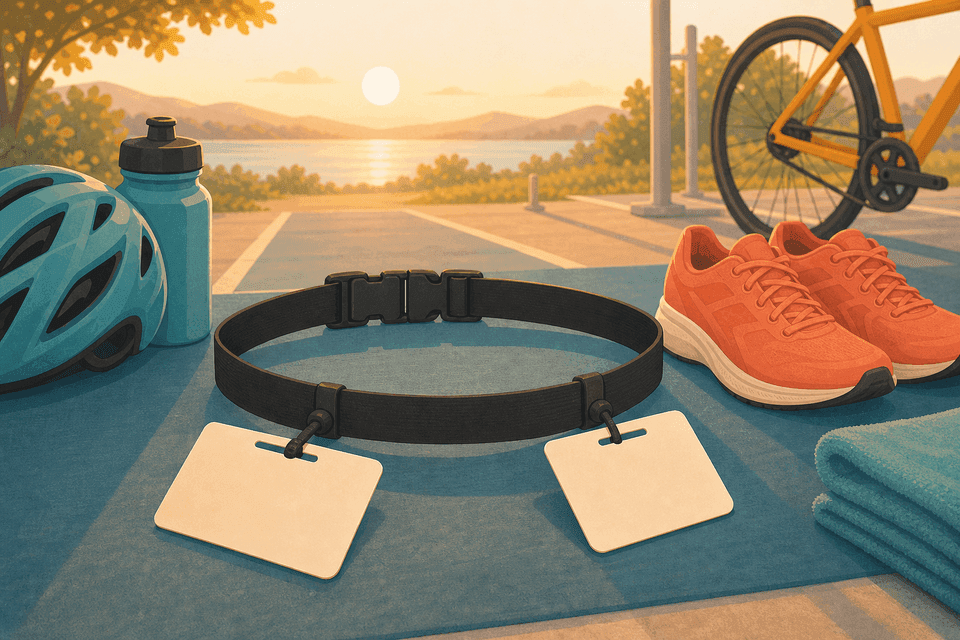
A race belt is a thin elastic strap that goes around your waist, with two little clips or toggles that hold your paper race number (your "bib"). You pull it on, snap it shut, and your number sits flat against you. That is the whole invention. There is nothing electronic, nothing complicated, and nothing to learn.
The clever part is that it spins. Because the belt slides freely around your waist, you can wear your number on your back during the bike and then rotate it to the front for the run, all in about two seconds. No pins, no fiddling, no stopping.
Why Triathletes Use One
Here is the puzzle a race belt solves. In most races, you get one paper number, and the rules ask you to wear it a certain way. Often that means number to the back on the bike (so it is visible as you ride) and number to the front on the run (so it is visible as you finish). On top of that, plenty of events simply require the number to be showing during the run.
Now think about what you are actually wearing. You cannot safely pin a paper number to a wetsuit, and you really do not want to jab pinholes through a nice tri suit. Pins also tear wet paper to shreds. So the old "four safety pins through your shirt" approach from running races just does not fit triathlon.
The race belt sidesteps all of that. Your number clips to the belt, not to your clothing, so nothing gets punctured. And when the rules want the number front or back, you just spin the belt instead of repinning anything. It is one of those small tools that makes the whole day smoother, which is exactly what you want when you are new and have plenty else on your mind.
How to Use It (It Really Is This Simple)
You will put your number on the belt the night before or the morning of the race, calmly, at your kitchen table. Here is the rhythm:
- Thread your bib onto the belt using the clips or toggles, so the number faces outward.
- Leave the belt in your transition area, or put it on under your wetsuit if you prefer (more on that in a second).
- After the bike, as you head out for the run, clip the belt on and spin the number to the front.
Many beginners keep it even simpler: they leave the belt sitting on top of their shoes in transition and just grab it on the way out to the run. Putting it on is a two-second job. If you want a sense of how these little moves fit together on race day, I walk through the whole flow in my guide to moving through T1 and T2 transitions.
A quick note on the swim: most people do not wear the belt in the water, because the number can drag or tear. You leave it in transition and put it on after. Some folks wear the belt (without the number, or with the number tucked) under their wetsuit to save a step, but honestly, for your first race, just keep it in transition. One less thing to think about.
What to Look For When You Buy One
The good news is that almost any race belt will do the job, and the differences are small. Still, a few features are genuinely nice to have:
- A wide, soft elastic strap that lies flat and does not dig in or roll up.
- Sturdy clips or toggles that hold the number firmly so it does not flap on the bike.
- A buckle that is easy to snap one-handed when your fingers are cold and wet.
- An adjustable length, so it fits over a tri suit or a wetsuit alike.
- Optional little loops for gel packets, if you like carrying a snack on the run.
That is really it. You do not need anything fancy or expensive. A simple $10 belt will serve you for years.
Honest Talk: Do You Actually Need One?
No. Let me say that clearly, because I never want gear to feel like a wall between you and the start line. You can finish a triathlon without a race belt. You can improvise by safely pinning your number to your tri suit if your race allows it, or some events hand out adhesive number stickers. Plenty of people have crossed the line with a number flapping on a borrowed shirt and a huge grin.
But of all the small things you can buy, this is one of the best. For about $10, you remove a genuinely annoying problem and you make your transitions calmer. I put it in the same happy category as why elastic laces are worth it: tiny, cheap, optional, and a little bit lovely. If you want the bigger picture of what to prioritize, I lay it all out in the gear you actually need for your first triathlon, and the race belt sits firmly in the "nice and inexpensive" column.
Whether your first event is a Sprint, an Olympic, a 70.3, or one day a full Ironman, the belt does the same quiet job. Buy it once, and you will reach for it at every race after.
You Are More Ready Than You Think
If you take one thing from this, let it be that gear is never the barrier here. A race belt is a small kindness you give yourself, not a requirement to earn your place on the course. You already belong out there. So grab a cheap belt if you can, skip it if you cannot, and either way I will be cheering for you. Come find more friendly, beginner-first guides any time over at couchtotri.com, and I will see you at the finish.